






What's Happening?
Researchers from Louisiana State University (LSU) and the consulting firm Ailectric have developed an AI-powered technology called DeepFire, designed to predict and model wildfires. This technology recently received special recognition and a $100,000
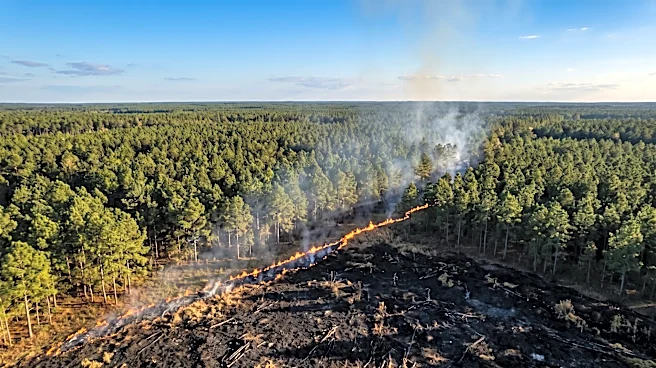
prize from the XPRIZE Wildfire competition. DeepFire is a comprehensive system that can predict where wildfires are likely to start, detect early signs of a fire, and model its spread. The system integrates data from satellites, smoke sensors, monitoring cameras, and other tools to inform its predictions. It can predict wildfires up to 35 days in advance, with 90% accuracy for predictions made four to seven days out. The technology aims to provide local fire departments with crucial information to enhance their response and enable preventative measures, such as controlled burns. DeepFire was tested in New South Wales, Australia, where it often detected wildfires before the local fire service. The technology has been licensed to Firemark AI, with future plans for commercialization to governments and fire departments.
Why It's Important?
The development of DeepFire is significant for U.S. wildfire management, particularly as the risk of extreme wildfires continues to increase nationwide. Louisiana, despite its typically damp climate, has seen a rise in vulnerability to wildfires due to increasing temperatures and low rainfall, with a 25% increase in risk projected over the next two decades and a 101% increase in estimated property damage. Annually, the U.S. experiences an average of over 72,000 wildfires, which can have devastating impacts, as seen with the Lahaina fire in Hawaii and the Palisades fires in California. This AI technology offers a proactive approach to wildfire prevention and mitigation, potentially saving lives, property, and natural resources. By providing early detection and spread modeling, DeepFire can significantly reduce response times, allowing firefighters to contain fires before they become catastrophic. The commercialization efforts by Firemark AI could make this advanced tool accessible to various levels of government and even individual property owners, fostering a more resilient national infrastructure against wildfire threats.
What's Next?
The researchers behind DeepFire, in collaboration with Firemark AI, plan to commercialize the technology, making it available to governments and fire departments. This will involve further development and deployment of the platform, potentially at individual property, municipal, and statewide levels. The goal is to make the technology affordable for even small towns. DeepFire's capabilities will also support preventative measures, such as identifying areas suitable for controlled burns. As wildfire seasons lengthen and intensify globally, the integration of AI and advanced data analytics into fire management is expected to become more widespread. The success of DeepFire in detecting fires earlier than traditional methods suggests a shift towards more predictive and preventative strategies in wildfire combat, potentially leading to a reduction in the scale and impact of future fire events across the U.S.
Beyond the Headlines
The emergence of AI technologies like DeepFire highlights a broader shift in how society approaches environmental challenges, moving from reactive responses to proactive, data-driven prevention. This technology underscores the ethical considerations of deploying AI in critical public safety sectors, emphasizing accuracy, reliability, and accessibility. The collaboration between academic institutions like LSU and private firms like Ailectric and Firemark AI exemplifies a growing trend of public-private partnerships driving innovation for societal benefit. Furthermore, the XPRIZE model, which incentivizes technological breakthroughs through competition, demonstrates an effective mechanism for accelerating solutions to urgent global problems. The long-term implications include a potential re-evaluation of land management practices, increased investment in technological infrastructure for environmental monitoring, and a deeper integration of artificial intelligence into disaster preparedness and response frameworks, ultimately aiming to mitigate the human and ecological costs of wildfires.