
What's Happening?
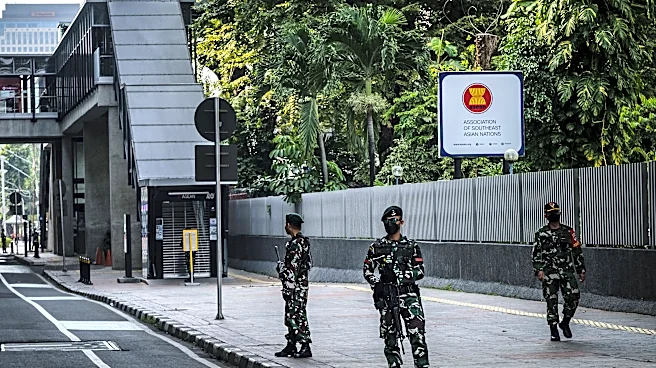
Fortify Rights, a human rights organization, has called upon leaders of the Association of Southeast Asian Nations (ASEAN) to recognize the Myanmar military junta's attacks on civilians as a demonstrable
threat to regional peace and security. The organization urges ASEAN to adopt concrete measures to address the situation during its upcoming summit in Manila. Fortify Rights specifically recommends that ASEAN refuse to recognize the junta as Myanmar's legitimate government, agree on measures to protect civilians, and pursue accountability for mass atrocity crimes. Since the February 2021 coup, the Myanmar military has been responsible for ongoing mass atrocity crimes, including war crimes, crimes against humanity, and the Rohingya genocide, leading to mass refugee outflows and humanitarian emergencies. Despite ASEAN's Five-Point Consensus, established in April 2021 to address the crisis, the junta has flouted each point, and its attacks on civilians continue unabated. The U.S. has also engaged in direct talks with the military, expressing interest in rare earth minerals and closing scam centers, and has recently lifted sanctions against some figures associated with the junta, a move Fortify Rights deems dangerous and counterproductive.
Why It's Important?
Fortify Rights' call highlights the critical need for a more robust and unified international response to the ongoing crisis in Myanmar. The current ASEAN approach, anchored in the Five-Point Consensus, has demonstrably failed to achieve its objectives, leading to continued violence and human rights abuses. Recognizing the junta as a threat to regional peace and security would elevate the issue beyond internal affairs, potentially paving the way for stronger collective action. The organization's recommendations aim to prevent the legitimization of a regime accused of genocide and widespread atrocities, which could have long-term implications for human rights and democratic norms in Southeast Asia. The U.S.'s engagement with the junta, driven by economic and security interests, complicates the international stance and raises concerns about prioritizing strategic gains over human rights. The failure to hold the junta accountable could embolden other authoritarian regimes and undermine the principles of international justice and humanitarian protection.
What's Next?
The upcoming ASEAN summit in Manila will be a crucial test of the bloc's willingness to reassess its approach to Myanmar. Fortify Rights is urging ASEAN leaders to move beyond their current 'meek moral censure' and adopt concrete measures. These could include coordinating restrictions on arms transfers and aviation fuel, imposing targeted financial restrictions, and supporting a referral of the situation in Myanmar to the International Criminal Court (ICC). Two ASEAN members, Timor-Leste and Cambodia, are ICC members and could unilaterally refer the situation. The organization also stresses that bilateral dealings with Myanmar by individual ASEAN member states should align with these objectives rather than undermine them. The International Court of Justice's ruling on November 19 regarding the Rohingya genocide will add further pressure and context to these discussions, potentially influencing ASEAN's collective decision-making and the broader international response to the crisis.
Beyond the Headlines
The situation in Myanmar, as highlighted by Fortify Rights, exposes the complex interplay between geopolitical interests, economic considerations, and human rights. The U.S.'s engagement with the junta, despite its human rights record, underscores the strategic importance of Myanmar's rare earth minerals and the desire to address issues like scam centers targeting Americans. This pragmatic approach, however, risks being perceived as a tacit endorsement of the military regime, potentially undermining efforts to promote democracy and accountability. The ongoing debate within ASEAN reflects a broader challenge for regional organizations: how to balance the principle of non-interference with the responsibility to protect populations from mass atrocities. The failure to act decisively could set a dangerous precedent, suggesting that economic and strategic interests can override fundamental human rights concerns. The long-term implications include the erosion of international norms against genocide and crimes against humanity, and the potential for prolonged instability and suffering for the people of Myanmar.