







What's Happening?
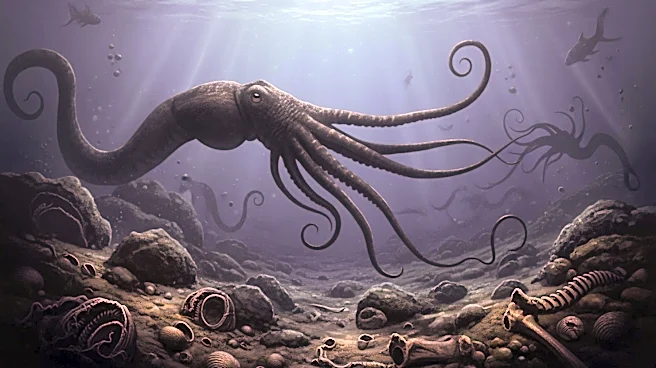
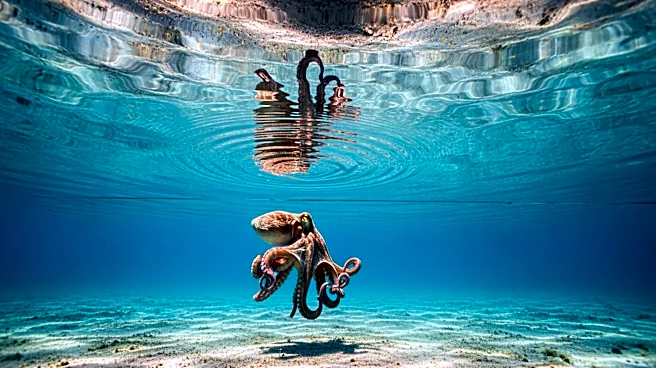
Researchers at Dartmouth College have discovered that octopuses can use mirrors to locate food that is not directly visible, showcasing their sophisticated spatial cognition. The study, published in Current Biology, involved experiments with California
two-spot octopuses (Octopus bimaculoides) in Dartmouth's Octopus Lab. The octopuses were trained to understand the relationship between a reflection and the real world. During the experiments, a virtual crab image was used to prevent the octopuses from relying on their chemoreceptors, which allow them to smell and taste through touch. The octopuses had to recognize the location of the image through the mirror and move towards it to receive a live crab reward. The animals successfully chose the correct side about 73% of the time, demonstrating their ability to use mirrors to infer spatial information.
Why It's Important?
This discovery is significant as it highlights the advanced cognitive abilities of octopuses, which are evolutionarily distant from humans. The ability to use mirrors for spatial cognition was previously documented only in vertebrates, such as some mammals and birds. The findings suggest that octopuses may have evolved similar neural solutions to spatial challenges, indicating convergent evolution. This research provides insights into the evolution of intelligence and the cognitive processes underlying spatial awareness. Understanding these processes in octopuses could lead to broader implications for studying intelligence in other species and contribute to the field of cognitive neuroscience.
What's Next?
Further research is needed to determine whether octopuses maintain mental maps of their environment, which could enhance their hunting strategies. The study opens up new avenues for exploring the cognitive abilities of invertebrates and their evolutionary significance. Researchers may continue to investigate the neural mechanisms that enable octopuses to process spatial information and how these abilities compare to those of vertebrates. This could lead to a deeper understanding of the evolution of intelligence across different species.
Beyond the Headlines
The study raises questions about the ethical considerations of using intelligent animals like octopuses in research. As our understanding of their cognitive abilities grows, there may be increased scrutiny on the treatment and welfare of octopuses in scientific studies. Additionally, the findings could influence the way we perceive and interact with marine life, potentially impacting conservation efforts and policies aimed at protecting these intelligent creatures.