
What's Happening?
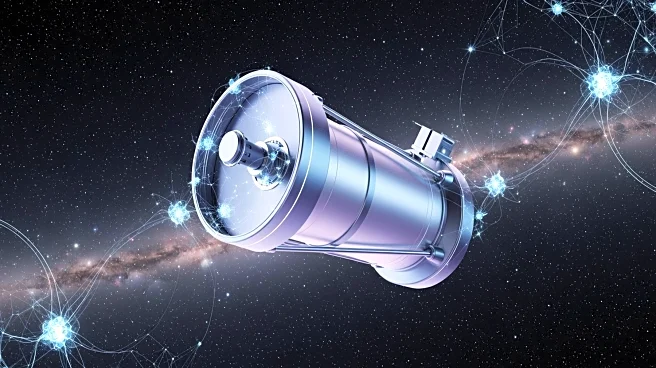
NASA's Roman Space Telescope is set to employ machine learning (ML) techniques to analyze data from its large-scale structure (LSS) survey. The project, led by Shirley Ho from New York University, aims
to address fundamental questions about the universe's origins, content, and future. The ML methods proposed include Bayesian statistical inference, unsupervised learning, and diffusion models, which will help extract cosmological parameters and initial conditions of the universe. These methods are designed to overcome challenges posed by nonlinear gravitational evolution, which traditional methods struggle to address.
Why It's Important?
The integration of machine learning into the Roman Space Telescope's mission represents a significant advancement in astrophysics and cosmology. By optimizing data extraction from LSS surveys, these ML methods could lead to groundbreaking discoveries about the universe's fundamental physics. This approach not only enhances the scientific capabilities of the Roman mission but also sets a precedent for future space-based LSS missions. The development of a community framework for testing and comparing ML methods further promotes collaboration and innovation in the field.
What's Next?
The project will focus on creating deep-learning accelerated simulated datasets to test and benchmark different ML methods. These datasets will be made publicly available to encourage community engagement and support open access to ML tools. The results of this study are expected to improve the information content of existing LSS analysis methods, potentially unlocking new insights into the universe's fundamental physics. The success of this initiative could influence the design and implementation of future space missions.