




What's Happening?
The Central Arizona Project (CAP) has decided to discontinue its funding for a cloud seeding program aimed at increasing snowpack in the Colorado River basin. This decision, made during a recent board meeting, marks a significant shift for CAP, which
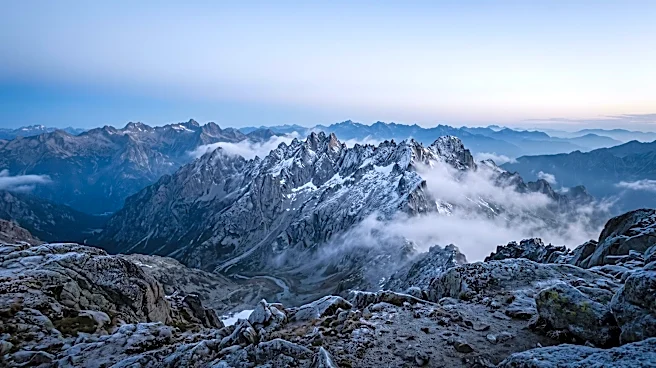
has been a part of collaborative cloud seeding efforts in Colorado, Utah, and Wyoming since 2007. The program's objective was to boost snow totals in the mountains where the Colorado River originates by releasing particles into the air to encourage clouds to drop moisture. In recent years, water agencies in Arizona, California, and Nevada collectively contributed approximately $1.5 million annually to this upstream cloud seeding work. However, CAP board members expressed skepticism regarding the program's effectiveness and the ability to accurately measure its outcomes. Board member Stephen Miller noted that while scientific studies suggest cloud seeding can add snow, quantifying the exact amount remains challenging. Another board member, Alexandra Arboleda, questioned the value for Arizona's Colorado River users and taxpayers.
Why It's Important?
This decision by the Central Arizona Project is important because it reflects a growing skepticism within water management agencies regarding the practical efficacy and cost-effectiveness of geoengineering techniques like cloud seeding, especially in the context of severe aridification. The Colorado River is a critical water source for millions of people and vast agricultural areas across the Southwestern United States. Any measure, or lack thereof, to augment its flow has significant implications for water security and economic stability in the region. The withdrawal of CAP's funding, which was a substantial part of the overall investment in cloud seeding, could lead other participating agencies in Nevada and California to re-evaluate their contributions. This could potentially diminish the scale of future cloud seeding operations, impacting water supply strategies for states heavily reliant on the Colorado River. The debate over measurable outcomes also highlights broader challenges in implementing and assessing climate intervention technologies.
What's Next?
Going forward, the remaining water agencies involved in the upstream cloud seeding efforts will need to decide how to proceed without CAP's financial contribution. The program's funding structure was set to cap each agency's contribution at $525,000 per year in 2027, gradually increasing to $750,000 per year by 2036. CAP's withdrawal will likely necessitate a re-evaluation of these financial commitments and the overall viability of the program. Other agencies, such as those in Las Vegas and Los Angeles, along with major farming districts in Southern California, will need to assess whether they can sustain the program or if alternative water augmentation strategies are more appropriate. The scientific community may also face increased pressure to provide more definitive data on the measurable impact of cloud seeding to address the skepticism voiced by CAP board members.
Beyond the Headlines
The Central Arizona Project's decision underscores a broader societal and political challenge in addressing climate change and water scarcity. While geoengineering technologies like cloud seeding offer potential solutions, their implementation is often met with questions about scientific certainty, ethical implications, and equitable resource allocation. The move away from cloud seeding by a major water provider could signal a shift towards prioritizing more conventional water conservation methods or other, perhaps more proven, water management strategies. It also highlights the difficulty in gaining public and institutional trust for technologies where the benefits are hard to quantify precisely, especially when significant public funds are involved. This case may influence future discussions and investments in climate intervention technologies, emphasizing the need for robust scientific validation and clear economic justification.