




What's Happening?
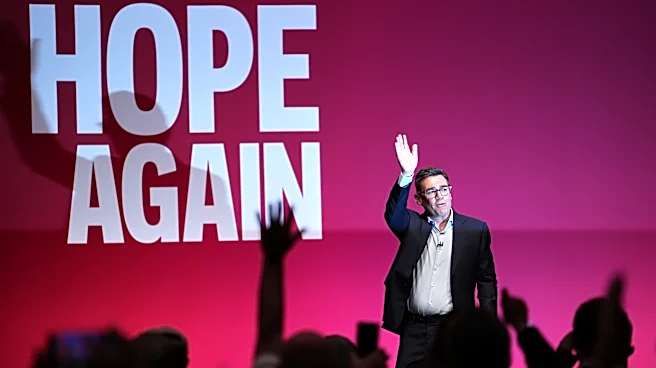
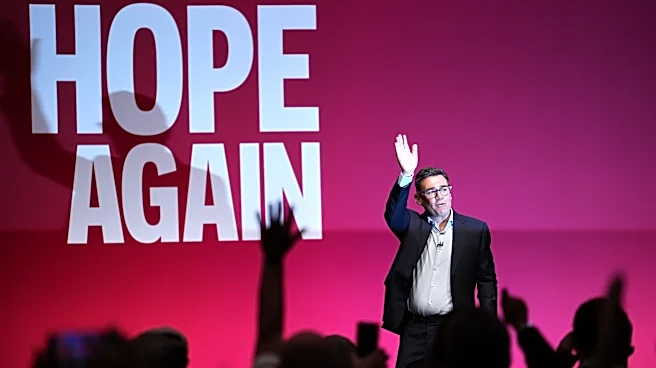
UK Prime Minister Andy Burnham has initiated a discussion about Britain potentially rejoining the European Union, a move that reopens the contentious Brexit debate. Speaking at his party's annual conference, Burnham stated that Britain's 2020 departure
from the EU has caused 'more harm than good,' leading to 'a decade of low growth.' He committed to outlining 'different options' for future ties with Europe ahead of a planned summit with the 27-member bloc later this year. These options could include rejoining the European single market, the customs union, or even 'going all the way' to full EU membership. This announcement marks a significant shift from previous political stances that largely avoided revisiting the Brexit decision. European leaders, including French President Macron and Spanish Prime Minister Sanchez, have expressed positive reactions to Burnham's initiative, indicating a willingness to engage with the UK on new terms. However, right-wing rivals in the UK have criticized the comments, suggesting a potential re-run of the 'Brexit wars' that followed the 2016 referendum.
Why It's Important?
The reopening of the Brexit debate by Prime Minister Burnham carries significant implications for the UK's economic and political future, as well as for its relationship with the European Union. Brexit, which occurred on January 31, 2020, after a 2016 referendum, has been linked by Burnham to a 'decade of low growth.' A potential re-evaluation of the UK's relationship with the EU could lead to substantial changes in trade agreements, economic policies, and international standing. Rejoining the single market or customs union, or even full EU membership, would likely alter trade flows, regulatory frameworks, and potentially attract foreign investment that may have been deterred by Brexit. For the U.S., a more stable and economically integrated UK could be a stronger trading partner and ally. Conversely, a prolonged and divisive debate over rejoining could create political instability and economic uncertainty, impacting transatlantic relations and trade. The willingness of European leaders to engage with Burnham's proposals suggests a potential for renewed cooperation, which could strengthen the Western alliance in a complex global environment.
What's Next?
Prime Minister Burnham is expected to set out various options for the UK's future relationship with Europe ahead of a planned summit with the 27-member EU bloc later this year. These options will likely include rejoining the European single market, the customs union, or potentially full EU membership. The proposals will be subject to intense debate within the UK, with right-wing parties already criticizing the move and warning of a return to the 'Brexit wars.' Public opinion polls suggest a growing sentiment in favor of rejoining the EU, with a June poll indicating 55% of voters would opt to rejoin if another referendum were held. Burnham has hinted that if public opinion continues to favor re-entry, he might commit to another referendum in Labour's next election manifesto, though the next general election is not anticipated until 2029. European leaders have expressed openness to engaging with the UK's proposals, signaling a potential path for renewed negotiations and a redefinition of the UK-EU relationship.
Beyond the Headlines
The re-ignition of the Brexit debate by Prime Minister Burnham delves deeper than mere economic or political calculations; it touches upon fundamental questions of national identity, sovereignty, and the UK's place in the world. The initial Brexit vote in 2016 exposed deep societal divisions, and revisiting this issue risks re-opening those wounds, potentially leading to renewed social and political polarization. Ethically, the debate will force a re-evaluation of the promises made during the original referendum campaign versus the realities experienced post-Brexit. Legally, any move towards rejoining the EU, even partially, would necessitate complex negotiations and potential changes to UK law to align with EU regulations. Culturally, it could shift perceptions of British identity, moving away from a more isolationist stance towards greater European integration. The long-term shift could see the UK either solidify its independent global role or gradually reintegrate into the European framework, with profound implications for its economic model, social fabric, and international alliances.