







What's Happening?
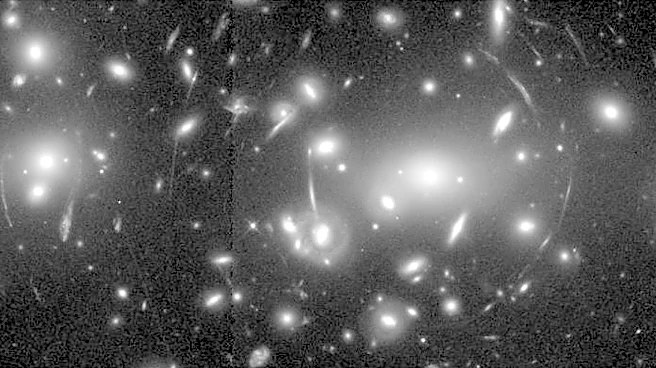
A recent study has brought into question the existence of dark matter in the Bullet Cluster, a well-known astronomical feature consisting of two colliding galaxy clusters located about 3.7 billion light-years from Earth. Traditionally, the Bullet Cluster has been
considered strong evidence for dark matter due to the gravitational lensing effects observed, which suggest the presence of unseen mass. However, new research using data from the James Webb Space Telescope proposes an alternative explanation that does not involve dark matter. The study suggests that the observed gravitational effects could be explained by Modified Newtonian Dynamics (MOND), a theory that eliminates the need for dark matter. This finding challenges the conventional understanding of dark matter's role in the universe.
Why It's Important?
The implications of this study are significant for the field of cosmology and our understanding of the universe. Dark matter is thought to make up about 85% of the universe's mass, influencing the formation and behavior of galaxies. If the MOND theory is validated, it could lead to a paradigm shift in how scientists understand gravitational forces and the structure of the universe. This could impact various scientific models and theories that currently rely on the existence of dark matter. Additionally, the study could influence future research directions and funding in astrophysics, as scientists may need to explore alternative explanations for cosmic phenomena.
What's Next?
The study's findings are likely to spark further debate and research within the scientific community. Researchers may conduct additional observations and simulations to test the MOND theory against other cosmic structures and phenomena. The scientific community will likely scrutinize the study's methodology and results to assess their validity. If MOND gains more support, it could lead to revisions in textbooks and educational materials related to astrophysics and cosmology. Furthermore, the study may encourage the development of new technologies and instruments to better observe and understand the universe's hidden components.
Beyond the Headlines
The study also raises philosophical and theoretical questions about the nature of the universe and the limits of human understanding. If dark matter does not exist, it challenges the notion of 'invisible' forces shaping the cosmos, prompting a reevaluation of how we perceive and measure reality. This could lead to broader discussions about the scientific method and the assumptions underlying current scientific theories. Additionally, the study highlights the importance of technological advancements, such as the James Webb Space Telescope, in expanding our knowledge and challenging established scientific beliefs.