



What's Happening?
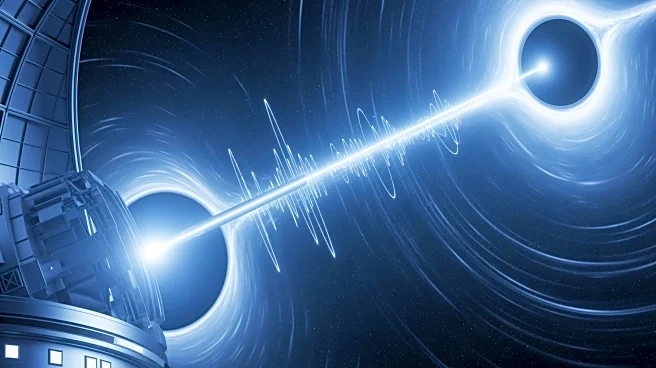
Researchers at KAIST, in collaboration with several institutes, have developed a new technology using optical frequency comb lasers to improve the observation of black holes. This technology allows for precise synchronization of radio telescopes, which
is crucial for capturing clear images of distant celestial bodies. The optical frequency comb laser emits multiple precise frequencies, acting as an 'ultra-precision ruler' for aligning the phases of signals received by telescopes. This advancement addresses previous limitations in phase alignment, which were challenging at higher observation frequencies. The technology has been successfully tested at the Korea VLBI Network, demonstrating its potential to enhance the precision of astronomical observations.
Why It's Important?
The development of this laser technology is a significant breakthrough in the field of astronomy, particularly for the study of black holes. By improving the precision of radio telescope observations, scientists can obtain clearer images and more accurate data, which are essential for understanding the nature and behavior of black holes. This technology also has broader implications for other fields that require precise space-time measurements, such as space geodesy and deep-space probe tracking. The ability to synchronize telescopes with such high precision could lead to new discoveries and advancements in our understanding of the universe.
What's Next?
Following the successful implementation of this technology, researchers plan to expand its use to other observation sites, potentially leading to a global network of synchronized telescopes. This could revolutionize the way we observe and study distant astronomical phenomena. Additionally, the technology may be adapted for use in other scientific and industrial applications that require precise measurement and synchronization. As the technology is further developed and refined, it could pave the way for new research opportunities and collaborations across various scientific disciplines.