






What's Happening?
The month of October 2026 is set to offer several significant astronomical events for observers across North America. Kicking off the month, Saturn will reach opposition on October 4, positioning the planet directly opposite the Sun from Earth's perspective,
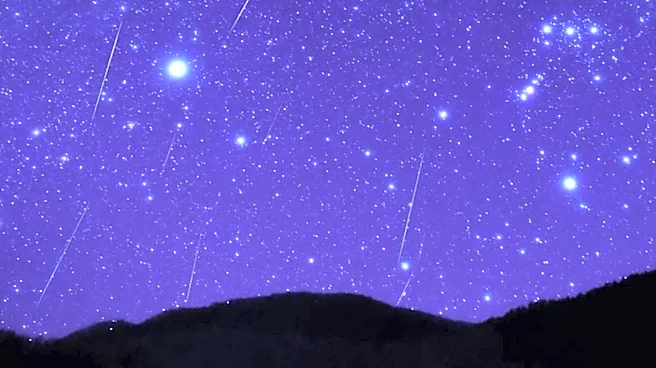
making it appear at its brightest and largest for the year. Following this, the Moon will pass Mars and Jupiter on October 5 and 6, respectively, with some regions experiencing lunar occultations of these planets. The Draconid meteor shower is expected to peak on the evening of October 8 into October 9, benefiting from a nearly dark sky due to the upcoming New Moon. Later in the month, the Orionid meteor shower will peak around October 21-22, though its visibility will be somewhat hampered by a bright waxing gibbous Moon. The month concludes with the Hunter's Moon on October 25-26, offering opportunities for lunar photography.
Why It's Important?
These celestial events provide unique opportunities for both amateur and experienced skywatchers, as well as astrophotographers, to engage with the cosmos. Saturn's opposition offers optimal viewing conditions for its rings, even with small telescopes, making it accessible to a broad audience. The lunar conjunctions and occultations of Mars and Jupiter highlight the dynamic movements within our solar system and can serve as educational moments for the public. Meteor showers like the Draconids and Orionids, despite varying intensity and lunar interference, connect observers to the debris trails of comets, offering a glimpse into the solar system's history. The Hunter's Moon, a cultural and astronomical event, encourages public engagement with lunar cycles and photography, fostering a deeper appreciation for natural phenomena.
What's Next?
Observers planning to view these events should monitor local weather forecasts, as clear skies are crucial for visibility. For Saturn's opposition, while October 4 is the peak, the planet will remain an excellent target for several days. Those interested in the Draconid meteor shower should prioritize the evening of October 8, taking advantage of the dark sky conditions. For the Orionids, the best viewing will be in the hours before sunrise on October 22, after the Moon has set. Astrophotographers should prepare their equipment, especially for deep-sky targets around the October 10 New Moon and for planning Hunter's Moon compositions. Specific timings for lunar occultations of Mars and Jupiter will vary by geographic location, so consulting planetarium apps or occultation maps is recommended for precise viewing details.
Beyond the Headlines
Beyond the immediate visual spectacle, these astronomical occurrences contribute to scientific understanding and public awareness of space. The study of meteor showers, for instance, helps scientists understand the composition and distribution of cometary debris. Public engagement with events like planetary oppositions and lunar phases can inspire interest in STEM fields and promote dark-sky conservation efforts by highlighting the impact of light pollution on astronomical observation. The accessibility of many of these events, even with minimal equipment, underscores the universal appeal of astronomy and its capacity to connect individuals to the larger universe, fostering a sense of wonder and curiosity about our place within it.