



What's Happening?
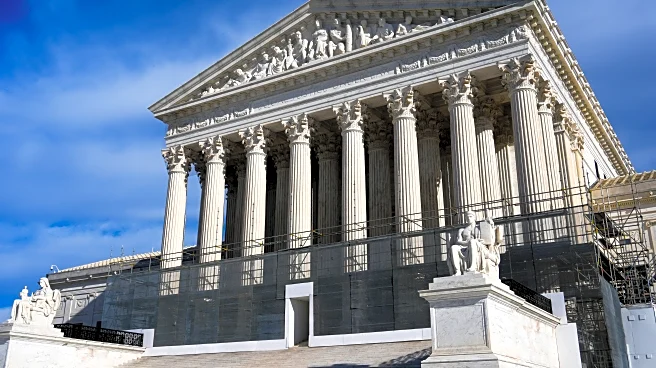
The U.S. Supreme Court has ruled that President Trump did not have the authority to unilaterally impose tariffs under the International Emergency Economic Powers Act (IEEPA). In a 6-3 decision, the court determined that the president lacked the necessary
congressional approval to impose such tariffs during peacetime. President Trump had previously invoked IEEPA to justify tariffs on overseas movie and TV production, citing a national emergency. However, the court found that the law did not grant him the power to impose tariffs of unlimited amount, duration, and scope without clear congressional authorization.
Why It's Important?
This ruling is significant as it curtails the executive power of the president to impose tariffs without legislative backing, reinforcing the constitutional requirement for checks and balances. The decision impacts U.S. economic policy, particularly in how tariffs are used as a tool in international trade negotiations. It also affects industries reliant on imports, as tariffs can increase costs for consumers and businesses. The ruling may lead to a reevaluation of existing tariffs and influence future trade policies, potentially affecting global trade dynamics and economic partnerships.
What's Next?
Following the Supreme Court's decision, there may be legislative efforts to clarify or amend the IEEPA to define the scope of presidential powers in imposing tariffs. Congress could take steps to assert its role in trade policy, potentially leading to new legislation that outlines the conditions under which tariffs can be imposed. Additionally, countries affected by the tariffs may seek to renegotiate trade agreements with the U.S., aiming for more stable and predictable trade relations.