
What's Happening?
Students from Danville Area High School in Pennsylvania recently demonstrated their advanced agricultural skills and the use of equipment acquired through state grants to Agriculture Secretary Russell
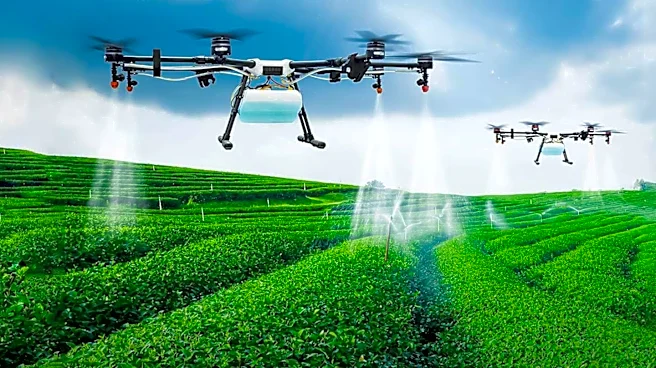
Redding and State Rep. Michael Stender. The visit highlighted the practical application of technology in agriculture, particularly the use of drones for precision farming. Students in Advanced Placement Environmental Science and Honors Veterinary Science classes, supervised by agricultural science teachers Van Wagner and Mike Schultz, showcased how drones are used to monitor crops for damage, disease, moisture, maturity, and bloom count. These drones also facilitate targeted spraying, seeding, and other crop treatments. Secretary Redding emphasized that providing students with these technology skills prepares them for future employment in Pennsylvania's agriculture industry.
Why It's Important?
This initiative is crucial for the future of the U.S. agricultural sector, particularly in Pennsylvania. The integration of advanced technology like drones into agricultural education addresses the evolving needs of the industry, which is increasingly reliant on precision farming techniques. By equipping students with these skills, the program helps to cultivate a workforce capable of driving innovation and efficiency in agriculture. This directly impacts the economic stakeholders in the agricultural industry, as a skilled workforce can lead to increased productivity, reduced waste, and more sustainable farming practices. Furthermore, the program offers students a competitive edge, with some even qualifying for a drone pilot's license from the Federal Aviation Administration upon graduation, opening up diverse career opportunities within the tech-driven agricultural landscape. The state's investment through PA Farm Bill Agriculture and Youth Grants underscores a commitment to strengthening the agricultural workforce and ensuring the industry's long-term viability.
What's Next?
The program is set to continue its expansion, with the 2026-27 grant cycle for PA Farm Bill Agriculture & Youth Grants funded at $500,000. School districts and youth nonprofits are encouraged to apply for these grants, which provide direct funding of up to $7,500 and matching grants of up to $25,000. These funds support projects, programs, and equipment purchases that benefit youth and promote agriculture, vocational training, and leadership. The state budget also includes a $10 million increase in career and technical education funding, bringing Pennsylvania's annual investment in workforce development to $193 million. This sustained investment is expected to further integrate technology into agricultural education, preparing more students for the demands of a modern agricultural industry. The ongoing success of these programs will likely influence future policy decisions regarding agricultural education and workforce development.
Beyond the Headlines
Beyond the immediate benefits of workforce development, this program highlights a significant cultural and technological shift in agriculture. The traditional image of farming is being transformed by high-tech tools, requiring a new generation of agricultural professionals with diverse skill sets. This shift also raises ethical considerations regarding data privacy and the responsible use of drone technology in agricultural settings. The long-term implications include increased food security through more efficient farming, reduced environmental impact due to precision application of resources, and the potential for new economic models in rural communities. The program serves as a model for other states looking to modernize their agricultural education and prepare students for a future where technology and agriculture are increasingly intertwined, fostering a more resilient and innovative agricultural sector across the U.S.