
What's Happening?
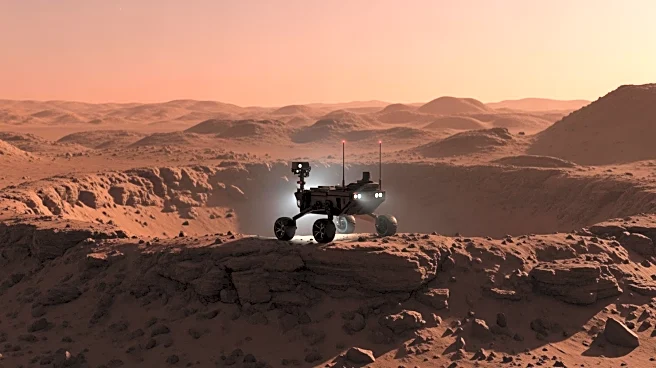
NASA's Perseverance Mars rover has successfully completed the first AI-planned drives on another planet, utilizing a generative AI system to navigate the rim of Jezero Crater. This groundbreaking demonstration,
conducted on December 8 and 10, 2025, involved the AI system creating waypoints for the rover, a task traditionally managed by human planners at NASA's Jet Propulsion Laboratory (JPL) in Southern California. The AI processed high-resolution images and terrain data to generate a sequence of waypoints, allowing the rover to adopt new commands as it traversed the Martian surface. This initiative, originating from JPL's Rover Operations Center, was executed in collaboration with Anthropic, which provided its Claude AI models for the trial. The AI-driven approach enabled Perseverance to cover significant distances across challenging terrain, demonstrating the potential for autonomous technologies to enhance mission efficiency and scientific return.
Why It's Important?
The successful implementation of AI in planning rover routes on Mars marks a significant advancement in space exploration technology. This development allows for more efficient operations, particularly as missions venture further from Earth, where communication delays make real-time control impractical. By automating complex decision-making tasks, AI can reduce the workload on human operators and increase the scientific yield of missions. The ability to autonomously navigate challenging terrain is crucial for future missions, including those aimed at establishing a human presence on the Moon and Mars. This technology not only streamlines current operations but also lays the groundwork for more sophisticated autonomous systems that could support long-term exploration and habitation of other planets.
What's Next?
Following this successful demonstration, NASA plans to further integrate AI into its mission planning processes. The technology could be expanded to include intelligent systems on rovers, helicopters, and other surface elements, potentially revolutionizing how missions are conducted. This approach could lead to kilometer-scale drives and more efficient data analysis, ultimately supporting the infrastructure needed for sustained human exploration of the Moon and Mars. As NASA continues to refine these technologies, they will play a critical role in future missions, enhancing the ability to explore and understand the Martian environment and beyond.