
What's Happening?
The American Enterprise Institute (AEI) is hosting an event titled 'China, America, and the Fragmentation of the Global Economy: A Conversation with Aaron Friedberg.' The discussion will center on the increasing
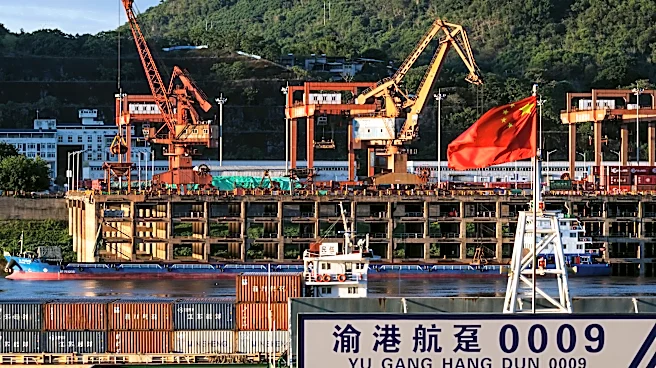
partial decoupling of the U.S. and Chinese economies, a phenomenon Friedberg refers to as the 'derisking race.' This race involves both nations striving to reduce their vulnerabilities to coercion or attack while simultaneously seeking to gain leverage over the other. This strategic competition is already leading to a fragmentation of the global economy and is expected to significantly reshape international trade and investment for years to come. Friedberg will delve into the historical roots of this derisking race and explain why competition and decoupling across strategic industries will be a defining characteristic of the future U.S.-China economic relationship.
Why It's Important?
The partial decoupling of the U.S. and Chinese economies has profound implications for U.S. industries, public policy, and global economic stability. As both countries strategically reduce their interdependence, U.S. businesses may face challenges in accessing Chinese markets or supply chains, while also potentially benefiting from increased domestic production and reduced reliance on foreign sources. This 'derisking race' could lead to significant shifts in global trade patterns, investment flows, and technological development. Industries deemed strategic, such as semiconductors, artificial intelligence, and advanced manufacturing, are at the forefront of this competition. The U.S. government's policies, including tariffs and technology restrictions, are aimed at safeguarding national security and promoting economic resilience, but they also carry the risk of higher costs for consumers and businesses. Understanding this dynamic is crucial for policymakers, business leaders, and economic stakeholders in the U.S. to navigate the evolving global landscape.
What's Next?
The event with Aaron Friedberg is expected to shed light on the future trajectory of the U.S.-China economic relationship, emphasizing continued competition and strategic decoupling. This suggests that U.S. policymakers will likely continue to pursue measures aimed at strengthening domestic industries, diversifying supply chains, and restricting the flow of sensitive technologies to China. Businesses, in turn, will need to adapt to a more fragmented global economy, potentially re-evaluating their international strategies and investments. The 'derisking race' is not a temporary phase but a long-term systemic rivalry that will necessitate ongoing adjustments from all stakeholders. Future policy decisions in the U.S. will likely focus on balancing economic competitiveness with national security concerns, further shaping the global economic order.
Beyond the Headlines
The concept of a 'derisking race' highlights a fundamental shift in international relations, moving beyond traditional economic integration towards a more strategic and security-driven approach to global commerce. This has deeper implications for the principles of free trade and globalization that have largely defined the post-Cold War era. The fragmentation of the global economy could lead to the emergence of distinct economic blocs, each centered around a major power, potentially fostering innovation within these blocs but also increasing geopolitical tensions. Ethically, questions arise about the fairness of state-backed industrial policies and their impact on global competition. Legally, the increasing use of trade restrictions and technology controls could challenge existing international trade frameworks. Culturally, this economic rivalry could fuel nationalistic sentiments and impact international collaboration on global challenges.