







What's Happening?
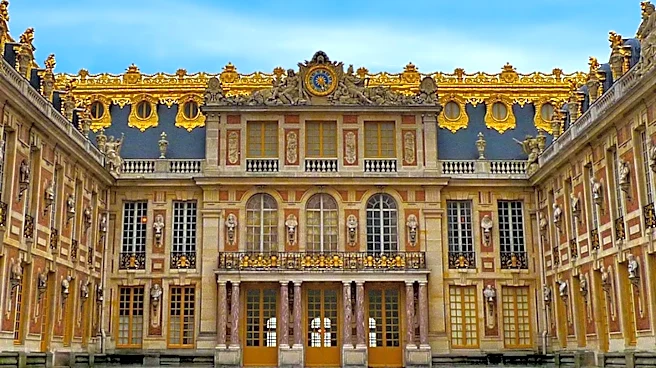
Guillaume Cerutti, 60, has been named the new president of the Palace of Versailles, ending an eight-month vacancy for the prestigious position. Cerutti, a graduate of France’s elite École nationale d’administration (ENA) and a former senior civil servant
in the finance ministry, succeeds Christophe Leribault. This appointment signifies Cerutti's return to public service after two decades in the private sector, where he held prominent roles in the art market. He previously served as head of Sotheby’s France and later as global chief executive of Christie’s, where he gained a reputation for financial discipline and cost-cutting. His career also includes a less successful stint as president of the Pinault Collection, which oversees venues in Venice and Paris, where his efforts to impose financial discipline reportedly led to conflict with Françoise Pinault.
Why It's Important?
Cerutti's appointment to lead the Palace of Versailles is significant for French cultural life, as the institution is a major historical and tourist attraction, welcoming 8.4 million visitors in 2025 and employing approximately 1,000 people. His extensive background in both public administration and the private art market, particularly his experience in financial management and securing patronage, will be crucial. The Palace of Versailles faces ongoing budgetary pressures, making Cerutti's ability to attract support from wealthy patrons and manage finances effectively a key asset. His return to public service, following in the footsteps of his mentor Jean-Jacques Aillagon, highlights a trend of experienced professionals transitioning between public and private sectors in France's cultural landscape.
What's Next?
As the new president, Cerutti will be tasked with navigating the budgetary challenges facing the Palace of Versailles and leveraging his connections in business, culture, and politics to secure necessary funding and support. His leadership will likely focus on maintaining the institution's prestige while ensuring its financial stability. The cultural sector in France, particularly large institutions like Versailles, often relies on a blend of public funding and private philanthropy, and Cerutti's proven track record in the latter will be closely watched. His previous experience with the Pinault Collection, though ending in conflict, demonstrates his commitment to financial discipline, which he may seek to implement at Versailles.
Beyond the Headlines
Cerutti's career trajectory, moving from high-level civil service to leading major art market players like Sotheby's and Christie's, and now back to a prominent public cultural institution, reflects a broader dynamic in France where expertise is often transferable across sectors. This movement can bring private sector efficiencies and fundraising strategies to public institutions, but also highlights potential clashes between commercial imperatives and cultural preservation, as seen in his tenure at the Pinault Collection. His appointment underscores the increasing need for cultural institutions to operate with business acumen while upholding their artistic and historical missions, especially in an era of constrained public finances.