




What's Happening?
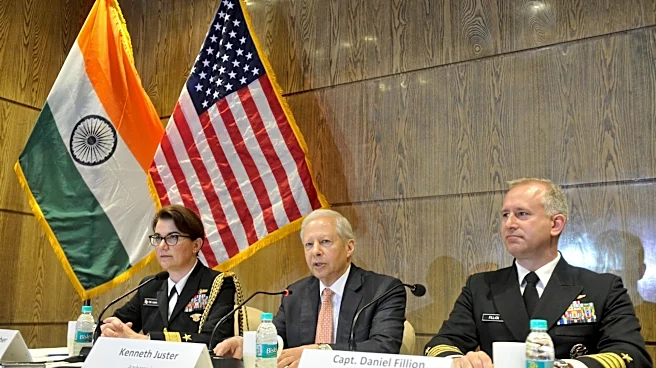
India is significantly enhancing its security coordination within the Indo-Pacific region through the Quadrilateral Security Dialogue (Quad), which includes the United States, Japan, and Australia. This initiative is a cornerstone of India's new strategic
alignment, focusing on ensuring a free, open, and inclusive Indo-Pacific. The Quad facilitates joint military exercises, maritime domain awareness initiatives, and high-level policy coordination. This strategic convergence is further supported by defense agreements with the United States, such as the Communications Compatibility and Security Agreement (COMCASA) and the Logistics Exchange Memorandum of Understanding (LEMOA), which enable deeper military cooperation and real-time data sharing. The annual Malabar Exercises, involving naval drills among Quad members, serve as a practical demonstration of interoperability and shared intent in the region. Additionally, initiatives like the India-led International Solar Alliance and partnerships in critical technology represent non-military facets of this alliance, countering efforts such as China's Belt and Road Initiative.
Why It's Important?
This strengthened security coordination is crucial for maintaining stability and freedom of navigation in the Indo-Pacific, a region vital for global trade and security. The Quad's focus on upholding international law and securing sea lines of communication directly aligns with U.S. interests in a rules-based international order and countering potential hegemonic influences. For the U.S., this partnership enhances its strategic presence and influence in a critical geopolitical area, providing a multilateral framework to address shared security concerns. The interoperability fostered through joint exercises and defense agreements improves collective defense capabilities and intelligence sharing among key democratic allies. Economically, the collaboration on infrastructure and critical technology can offer alternatives to state-backed initiatives, promoting fair competition and sustainable development. This alignment also signals a broader commitment among these nations to democratic values and a balanced power structure in the region, impacting global diplomatic and economic landscapes.
What's Next?
The Quad nations are expected to continue expanding their joint military exercises and maritime domain awareness initiatives, further solidifying their interoperability and collective security posture in the Indo-Pacific. Future discussions will likely focus on deepening policy coordination on regional security challenges and exploring new avenues for technological collaboration. The ongoing implementation of defense agreements like COMCASA and LEMOA will facilitate more seamless information exchange and logistical support among the U.S. and India. There will also be continued efforts to promote infrastructure and technology partnerships that align with the Quad's vision of a free and open Indo-Pacific, potentially drawing in other like-minded nations. The evolution of these partnerships will be closely watched by other global powers, as they will shape the geopolitical dynamics and economic competition in the region for years to come.
Beyond the Headlines
The deepening of India's security coordination with the Quad nations represents a significant shift in its foreign policy, moving towards a more explicit alignment with Western democracies while still maintaining its historical ties. This 'multi-alignment' strategy allows India to balance its relationships, leveraging partnerships for both economic growth and strategic security without committing to a formal military alliance. The ethical implications revolve around the potential for increased regional tensions as major powers vie for influence, and the challenge of ensuring that these security arrangements do not inadvertently destabilize existing diplomatic frameworks. Culturally, this collaboration could foster greater understanding and exchange among the participating nations, but it also highlights the ongoing ideological competition between democratic and authoritarian models of governance. The long-term shift could see a more robust, multilateral security architecture in the Indo-Pacific, potentially redefining global power dynamics and trade routes.