






What's Happening?
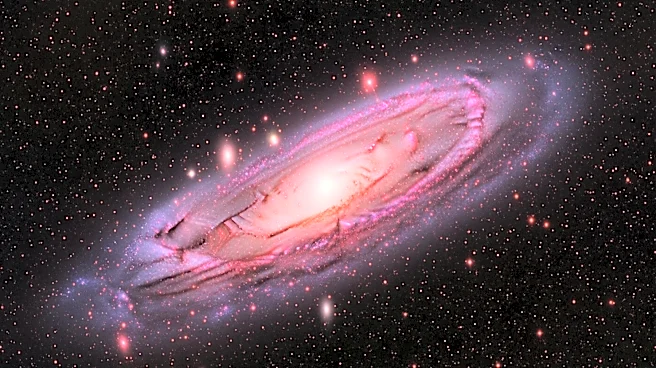
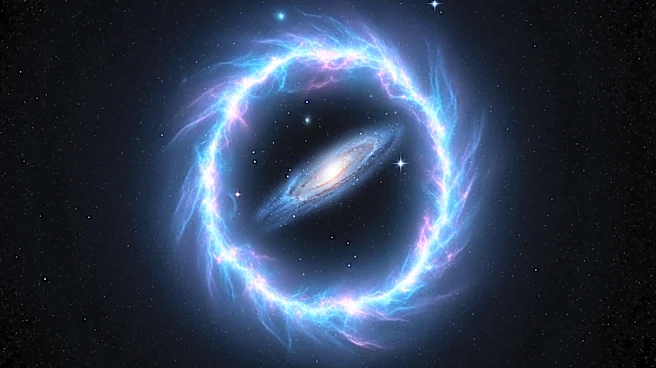
A recent study utilizing the Hobby-Eberly Telescope at the McDonald Observatory in Texas has uncovered a significant number of hydrogen gas halos surrounding galaxies, increasing the known count from about 3,000 to over 33,000. These halos, ranging from tens
of thousands to hundreds of thousands of light years across, include both simple, football-shaped clouds around single galaxies and larger, irregular structures containing multiple galaxies. This discovery provides a more comprehensive dataset for studying early galaxy formation and evolution, particularly during the 'cosmic noon' period 10 to 12 billion years ago when star formation was at its peak. The study, published in the Astrophysical Journal, highlights the importance of hydrogen gas as a fundamental component for star formation, which has been difficult to detect due to its faint emission.
Why It's Important?
The discovery of these hydrogen gas halos is crucial for understanding the early universe's structure and the processes that led to galaxy formation. By significantly expanding the number of known halos, researchers can now study the physics and mechanics of these structures in greater detail, potentially leading to revisions of existing models of galaxy formation. This could have profound implications for astrophysics, as it may alter our understanding of how galaxies evolve and interact over time. The findings also underscore the importance of advanced telescopic technology in uncovering previously hidden aspects of the universe, which could lead to further breakthroughs in cosmology.
What's Next?
Researchers plan to conduct detailed studies of the newly discovered hydrogen gas halos to better understand their role in the universe's evolution. This could involve refining existing models of galaxy formation or developing new ones to account for the increased number of halos. The study's findings may also prompt further observational campaigns using other advanced telescopes to explore these structures in different regions of the universe. As scientists continue to analyze the data, they may uncover additional insights into the distribution and behavior of hydrogen gas in the cosmos.