


What's Happening?
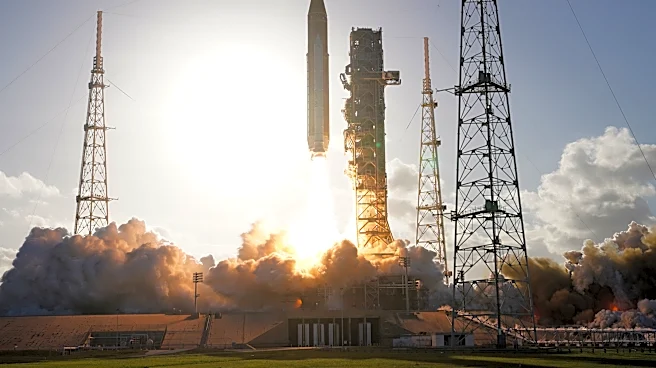
NASA's Artemis II mission has successfully launched from Kennedy Space Center, with four astronauts aboard the Orion spacecraft. The crew, including NASA astronauts Reid Wiseman, Victor Glover, Christina Koch, and Canadian astronaut Jeremy Hansen, is embarking
on a 10-day mission to orbit the moon. This mission is a critical test of the Orion spacecraft and its systems, as it aims to demonstrate the capabilities needed for future lunar landings and long-term human presence on the moon. The mission will also collect valuable scientific data on the effects of deep space travel on human health.
Why It's Important?
The Artemis II mission is a significant milestone in NASA's efforts to return humans to the moon and establish a sustainable presence there. By testing the Orion spacecraft's systems and capabilities, this mission lays the groundwork for future lunar exploration and potential missions to Mars. The success of Artemis II could lead to advancements in space technology and inspire further exploration efforts. Additionally, the scientific experiments conducted during the mission will provide insights into the challenges of long-duration space travel, contributing to our understanding of human health and performance in space.
What's Next?
Following the successful launch, the Artemis II crew will conduct a series of tests and experiments while in orbit. The mission is expected to last approximately 10 days, with the crew traveling on a trajectory that will take them around the moon and back to Earth. The data collected during this mission will be critical for planning and executing future Artemis missions, including potential lunar landings and the establishment of a permanent human presence on the moon. The success of Artemis II will be a crucial step towards achieving these long-term goals.