


What's Happening?
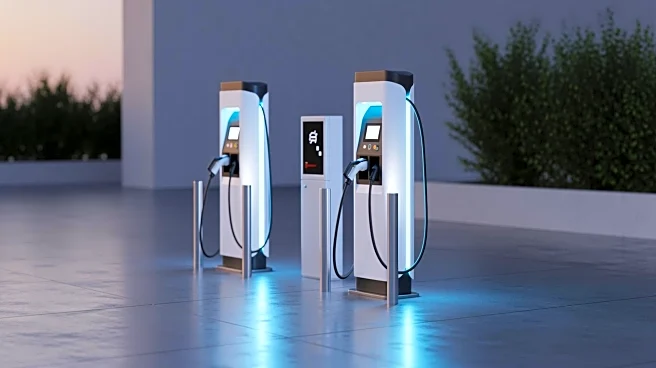
IONNA, a joint venture founded by eight global automakers, has launched new electric vehicle (EV) charging stations at Wally's in Pontiac, Illinois, and two Casey's locations in McHenry and Vernon Hills. These sites are part of a five-location rollout
across Illinois, with additional sites planned in Springfield, Chicago, North Aurora, St. Charles, Arlington Heights, and Des Plaines. The charging stations, referred to as 'rechargeries,' are equipped with multiple charging bays powered by ComEd and Ameren. This initiative is part of a broader effort to enhance EV infrastructure in Illinois, supported by the state's allocation of $148 million in federal funds for the National Electric Vehicle Infrastructure (NEVI) program. To date, $43.8 million has been awarded for 62 projects, facilitating the construction of 349 new charging ports.
Why It's Important?
The expansion of EV charging infrastructure in Illinois is crucial for supporting the growing number of electric vehicles in the state, which saw a 32.5% increase in battery electric vehicles in 2025. This development not only aligns with environmental goals but also stimulates economic growth by creating jobs and attracting investments. The state's commitment to EV infrastructure, despite the expiration of federal tax credits, is further bolstered by its own rebate program, offering financial incentives to EV purchasers. The involvement of private sector players like IONNA underscores the confidence in Illinois' EV market, which is essential for achieving long-term sustainability and reducing carbon emissions.
What's Next?
As Illinois continues to build out its EV infrastructure, the focus will likely remain on increasing the accessibility and affordability of electric vehicles. The state plans to expand its network of charging stations, with more locations set to open without federal or state grant support, indicating strong private sector engagement. This expansion is expected to further integrate EVs into everyday life, making them a viable option for more residents. Additionally, the state's ongoing rebate program will continue to incentivize EV purchases, potentially leading to a further increase in EV adoption.