



What's Happening?
Congressional Republicans are strategizing to pass key provisions of the Safeguarding American Voter Eligibility (SAVE) America Act through the budget reconciliation process before the November midterm elections. This legislative maneuver aims to bypass
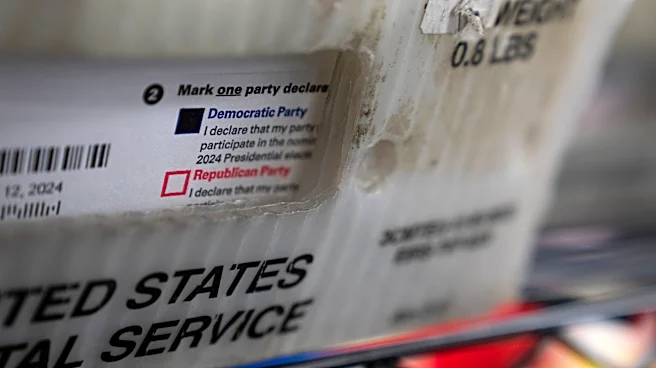
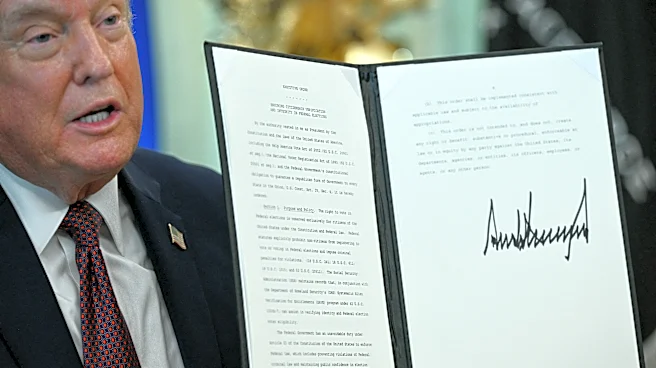
the Senate's 60-vote filibuster threshold, allowing the party in power to pass fiscal policy with a simple majority. The SAVE America Act, strongly supported by President Trump, includes mandates for proof of citizenship for voter registration and a nationwide photo ID requirement for casting a ballot. House Administration Committee Chairman Bryan Steil is tasked with overseeing the inclusion of these provisions. The House has already passed a $95 billion budget, part of which is intended for election security, and the White House has indicated its support for using reconciliation to advance these reforms. Democrats have consistently opposed the SAVE America Act, labeling it as an attempt at voter suppression and an effort to undermine confidence in U.S. elections.
Why It's Important?
The potential passage of the SAVE America Act's provisions through budget reconciliation could significantly alter federal election laws, impacting voter access and election administration nationwide. Implementing a nationwide photo ID requirement and proof of citizenship for voter registration would standardize election procedures across states, potentially leading to increased voter confidence for some, while raising concerns about disenfranchisement for others. Proponents argue these measures are essential for election integrity, citing examples like Tennessee, which already has similar requirements. Opponents, primarily Democrats, contend that such requirements disproportionately affect minority groups, low-income individuals, and the elderly who may face challenges in obtaining the necessary identification or documentation. The debate highlights a fundamental partisan divide over the balance between election security and voter access, with potential long-term implications for democratic participation and the perceived legitimacy of election outcomes.
What's Next?
The immediate next step involves the House and Senate budget committees working to combine their respective budget frameworks into a single bill. House Administration Committee Chairman Bryan Steil is actively engaging with colleagues in the administration and Senate to push for the inclusion of the SAVE America Act's provisions. However, the budget reconciliation process is lengthy and complex, with a tight timeline before the November midterm elections. A significant hurdle will be the Senate parliamentarian, who will review the bill to ensure all provisions adhere to budget-related rules, potentially removing elements that do not directly impact the federal budget, tax policy, or national debt. While Republicans are optimistic about reaching an agreement, the differing spending totals between the House and Senate budget frameworks, and the need for identical bills to pass both chambers, present considerable challenges. The outcome will depend on the ability of Republican leadership to navigate these procedural complexities and secure sufficient votes in both the House and Senate.
Beyond the Headlines
The push to pass the SAVE America Act via budget reconciliation underscores a broader strategic shift in legislative tactics, where the majority party attempts to circumvent traditional legislative roadblocks like the filibuster for highly contentious issues. This approach could set a precedent for future policy debates, potentially leading to more frequent use of reconciliation for non-fiscal matters if they can be framed as having budgetary implications. Furthermore, the ongoing debate over voter ID laws and proof of citizenship requirements touches upon fundamental questions of civic identity and the rights of citizens. It reflects a deep ideological chasm regarding who should vote and how easy or difficult it should be to cast a ballot. The long-term implications could include a further erosion of bipartisan cooperation on election reform, increased litigation over voting rights, and a continued politicization of election administration, potentially impacting public trust in democratic institutions.