



What's Happening?
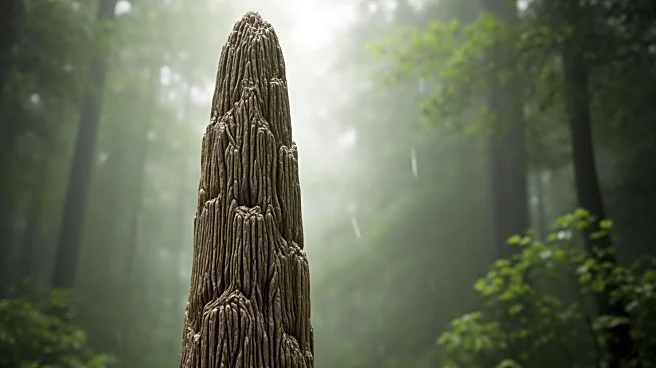
A recent study published in Science Advances has reignited debate over the classification of Prototaxites, a mysterious organism that lived over 400 million years ago. Initially thought to be a type of tree, Prototaxites has puzzled scientists due to its
unique structure and lack of clear classification within existing biological kingdoms. New research suggests it may not fit into any known category, challenging previous assumptions that it was a type of fungus. The study highlights the organism's distinct internal structures and absence of chitin, a key component of fungal cell walls, suggesting it may represent an entirely new form of life.
Why It's Important?
The study of Prototaxites is significant as it challenges the current understanding of life's evolutionary history. If Prototaxites represents a new biological kingdom, it could reshape the tree of life and provide insights into the diversity of ancient ecosystems. This discovery underscores the complexity of early life on Earth and the potential for undiscovered life forms. It also highlights the limitations of current classification systems and the need for continued exploration and research in paleobiology. Understanding such ancient organisms can inform modern biological and ecological studies, offering a broader perspective on life's adaptability and evolution.
What's Next?
Researchers aim to find other fossil life forms with similar chemical fingerprints to trace Prototaxites through the tree of life. This could involve re-examining existing fossil collections and conducting new field studies. The scientific community may also explore the implications of this discovery for understanding the evolution of complex life forms. Further research could lead to the identification of other unique organisms, expanding the known diversity of ancient life and potentially leading to the recognition of new biological kingdoms.