





What's Happening?
The U.S. Navy has experienced significant maintenance delays for its attack submarines over the past decade, leading to an estimated 15,000 lost operational days. A Government Accountability Office (GAO) study revealed that these delays have cost approximately
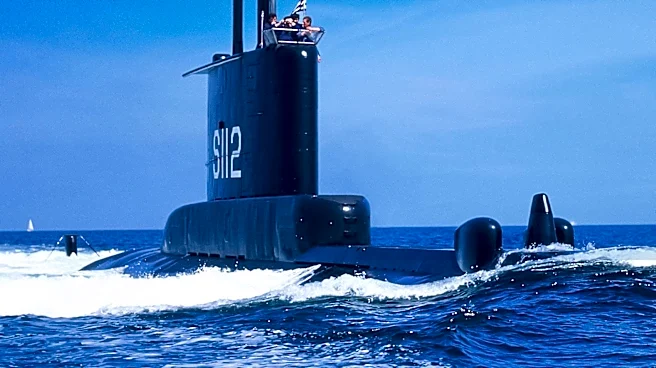
$3.4 billion to sustain crews and submarines that were unable to provide operational capability. This includes 'active idle time,' where submarines and their crews are pier-side, unable to deploy due to expired certifications or waiting for maintenance periods. For instance, Los Angeles-class subs incur nearly $220,000 per day in active idle costs, while Virginia-class subs cost over $237,000 daily. Compounding the issue are delays in decommissioning nuclear submarines, which have cost $722 million from 2016 to 2025, resulting in 'inactive idle time' as boats await shipyard capacity for defueling their nuclear reactors. The USS Pasadena, a Los Angeles-class submarine, became inactive in January 2025 but is not expected to enter a shipyard until November 2028, a delay estimated to cost over $300 million.
Why It's Important?
These maintenance backlogs and associated costs significantly strain the U.S. Navy's submarine fleet, impacting its readiness and operational capacity. The inability to deploy fully-crewed submarines due to maintenance delays means a reduction in available assets for critical missions, potentially affecting national security and strategic deterrence. The substantial financial outlay for idle submarines and crews represents a misallocation of resources that could otherwise be invested in fleet modernization, training, or other defense priorities. The GAO's findings highlight systemic issues within naval shipyard capacity, which is struggling with aging infrastructure and shortages of labor and materials. This situation not only affects current operational capabilities but also poses long-term challenges for maintaining a robust and responsive submarine force, especially in an evolving global security landscape where undersea capabilities are increasingly vital.
What's Next?
The U.S. Navy is exploring several options to address the maintenance crisis. One proposed solution is to allow nuclear reactors to be defueled while submarines are pier-side, rather than waiting for a shipyard slot, though the feasibility and cost-effectiveness of this option require further analysis. Another consideration is the use of floating dry docks for defueling, which also needs technical viability assessment. For inactive submarines awaiting decommissioning, the Navy is looking into transferring crews to active boats until shipyard slots become available, although this is limited by overall shipyard capacity. Additionally, extending the service life of submarines is being considered to mitigate decommissioning backlogs, but these extensions are still pending approval. The GAO warns that inactive idle time for submarines is projected to worsen, with an estimated 15 subs and 14,000 days of inactive idle time between 2026 and 2030, costing an additional $3.1 billion, underscoring the urgency for effective solutions.
Beyond the Headlines
The persistent maintenance issues within the U.S. Navy's submarine fleet reflect broader challenges in defense industrial base capacity and strategic planning. The reliance on a limited number of public and private shipyards for complex nuclear submarine maintenance creates a bottleneck that is difficult to alleviate quickly, given the specialized infrastructure and skilled workforce required. This situation could lead to increased pressure on the remaining operational submarines and their crews, potentially impacting morale and readiness. Furthermore, the long-term implications extend to the Navy's ability to project power and maintain a technological edge against potential adversaries. The need for sustained investment in shipyard infrastructure, workforce development, and innovative maintenance strategies is critical to ensure the U.S. retains its undersea dominance and effectively responds to global threats, highlighting a complex interplay between defense policy, industrial capability, and national security.