




What's Happening?
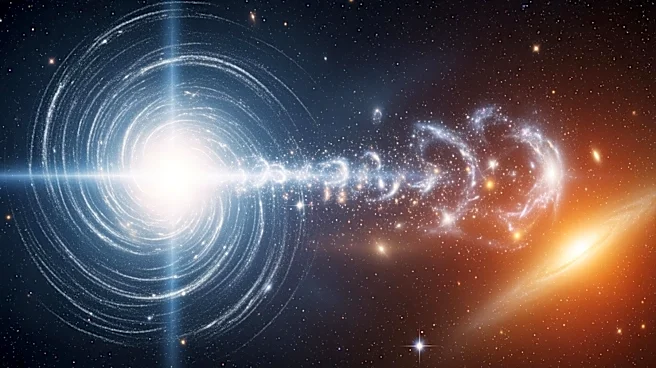
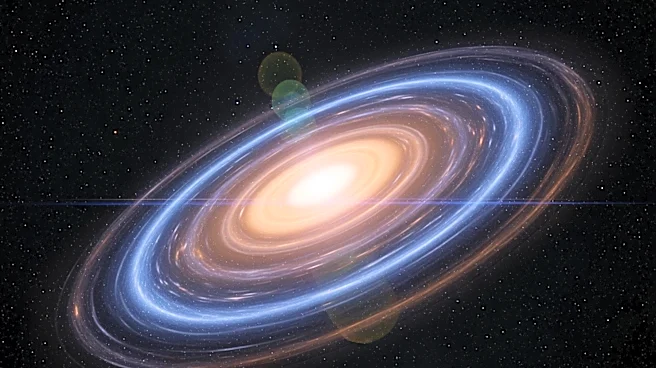
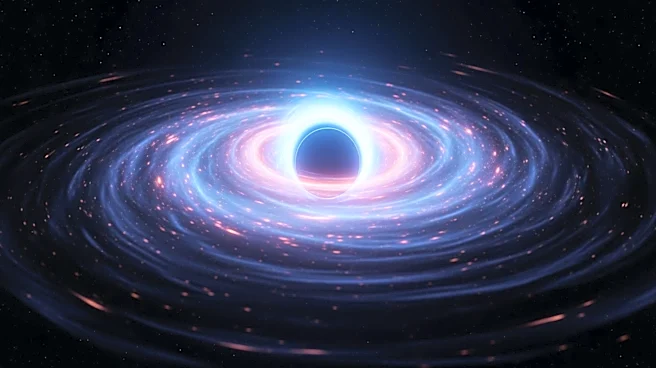
NASA's Hubble Space Telescope has captured detailed images of a massive planet-forming disk, known as IRAS 23077+6707, located nearly 1,000 light-years away. This colossal structure, nicknamed 'Dracula's Chivito,' spans approximately 400 billion miles,
making it one of the largest protoplanetary disks observed. The disk's chaotic environment, filled with towering streams of gas and dust, challenges existing models of planetary system evolution. The images reveal asymmetrical features and filament-like structures, providing a unique perspective on the dynamic processes involved in planet formation.
Why It's Important?
The discovery of such a large and chaotic planet-forming disk offers new insights into the early stages of planetary development. It suggests that planet formation may be more dynamic and turbulent than previously thought, with significant implications for our understanding of how planetary systems evolve. The findings could influence theories about the formation of giant planets and the conditions necessary for their development. This research also highlights the capabilities of the Hubble and James Webb Space Telescopes in studying distant cosmic phenomena.
What's Next?
Further observations of IRAS 23077+6707 are needed to understand the disk's internal structure and the processes shaping it. Future studies may focus on determining whether the central star is a single or binary system, which could significantly impact the disk's evolution. Researchers will continue to explore the asymmetrical features and their potential causes, such as external forces or internal turbulence. These efforts will contribute to a deeper understanding of planet formation and the diverse environments in which it occurs.