




What's Happening?
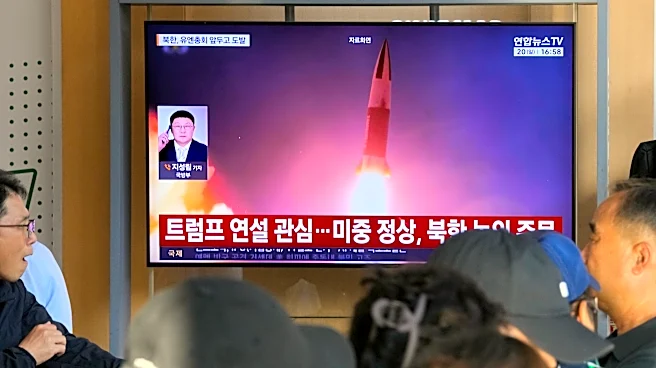
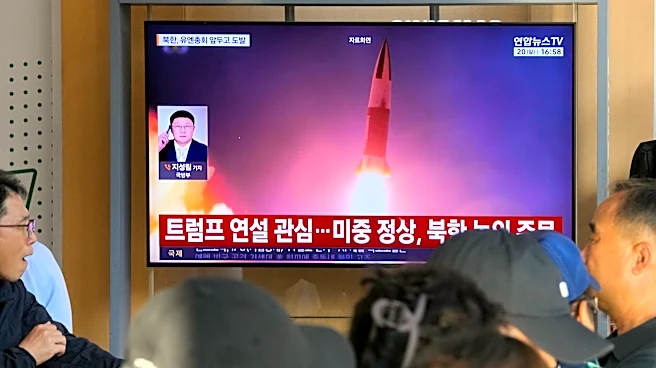
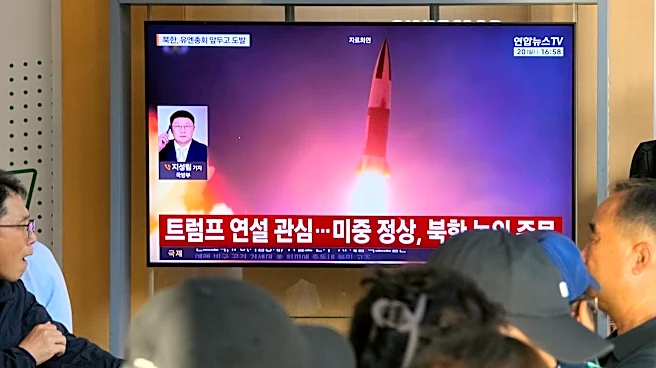
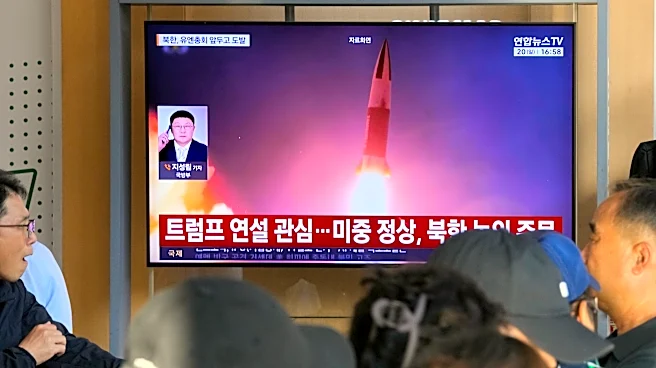
North Korea announced it successfully tested a new weapon on Sunday, showcasing what it described as 'ultra-modern defense technology.' The launch was overseen by leader Kim Jong Un, who lauded the progress in strengthening the country's war readiness,
according to state media reports on Tuesday. Kim stated that the test, conducted by North Korea’s Missile Administration, demonstrated a significant advancement in the armed forces' combat capabilities, asserting that 'the enemy will know better what such progress means without any explanation.' He further claimed that this development would inflict 'an incurable headache and a very cruel and unavoidable blow' upon adversaries. While the specific type of weapon was not detailed in the KCNA report, photographs showed Kim inspecting a screen displaying the 'flight trajectory' of a Hwasongpho-11-ma-1, believed to be an upgraded short-range ballistic missile variant equipped with a hypersonic glide vehicle.
Why It's Important?
This missile test holds significant implications for U.S. national security and regional stability in East Asia. The potential deployment of hypersonic glide vehicles by North Korea represents a substantial challenge to existing missile defense systems, including those operated by the U.S. and its allies in South Korea and Japan. Hypersonic missiles, capable of maneuvering at high speeds, are designed to evade conventional anti-missile defenses, complicating response strategies and potentially altering the strategic balance in the region. This advancement could necessitate significant investments in new defense technologies and intelligence capabilities for the U.S. and its allies. Furthermore, the test escalates tensions on the Korean Peninsula, directly impacting U.S. foreign policy and military posture in the Indo-Pacific, and potentially influencing international efforts towards denuclearization.
What's Next?
The U.S., South Korea, and Japan are expected to continue their close coordination regarding North Korea's military activities. Foreign ministers from these three nations recently met on the sidelines of the U.N. General Assembly to discuss peace, stability, and denuclearization on the Korean Peninsula. This latest test will likely prompt further diplomatic discussions, potential sanctions, and increased military exercises in the region by the U.S. and its allies. North Korea's continued development of advanced weaponry, particularly hypersonic missiles, suggests a sustained effort to upgrade its nuclear capabilities, which will remain a primary concern for international security. The U.S. will likely monitor further tests and intelligence to fully assess the capabilities of this new technology and adjust its defense strategies accordingly.
Beyond the Headlines
The rhetoric accompanying North Korea's missile test, with Kim Jong Un's assertion of inflicting an 'incurable headache' on the enemy, underscores a deeper psychological and political dimension to its weapons development. Beyond military capabilities, these tests serve as powerful propaganda tools, aimed at bolstering domestic support, projecting strength internationally, and extracting concessions from adversaries. The development of hypersonic technology also highlights a global arms race in advanced weaponry, where nations are seeking to gain a strategic edge through technological innovation. This trend could lead to increased instability and a heightened risk of miscalculation, as the speed and maneuverability of these weapons reduce decision-making time in potential conflict scenarios. For the U.S., understanding these broader implications is crucial for developing comprehensive strategies that combine deterrence, diplomacy, and defense innovation.