



What's Happening?
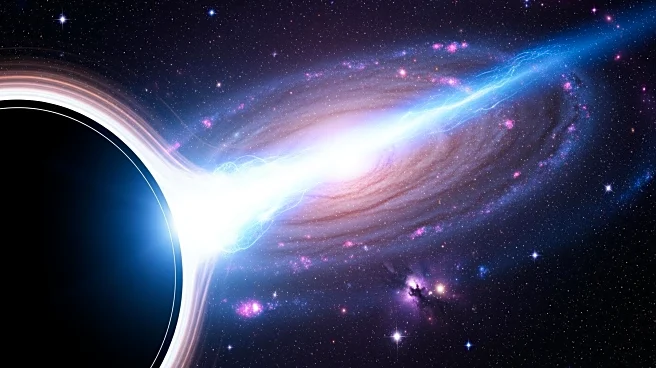
Astronomers have observed a jet of charged particles moving at nearly the speed of light, originating from a supermassive black hole that has torn apart a star. This event, known as a tidal disruption event (TDE), is one of the most luminous and energetic
phenomena ever recorded in the universe. The jet, associated with the event catalogued as AT2018hyz, is releasing energy levels between a trillion and 100 trillion times greater than the fictional Death Star's laser from Star Wars. The event was initially detected in 2018, but its extraordinary energy output became apparent only in 2022. The black hole is located in a galaxy 665 million light-years away, and the energy output is expected to peak in 2027.
Why It's Important?
The discovery of such a powerful jet has significant implications for our understanding of black holes and the dynamics of TDEs. It challenges existing models of how energy is emitted during these events and suggests that relativistic jets, though rare, can be far more energetic than previously thought. This finding could lead to new insights into the behavior of black holes and the conditions necessary for the formation of such jets. The event also highlights the potential for future discoveries with upcoming technologies like the Square Kilometer Array, which will enhance the ability to detect similar phenomena.
What's Next?
Astronomers, led by Yvette Cendes, plan to continue monitoring AT2018hyz to better understand the mechanisms behind its energy output. The ongoing observation will help determine how the jet's energy levels evolve and provide clues about the magnetic fields and other factors contributing to its formation. The upcoming Square Kilometer Array will play a crucial role in identifying more such events, potentially leading to a broader understanding of TDEs and their impact on surrounding cosmic environments.