
What's Happening?
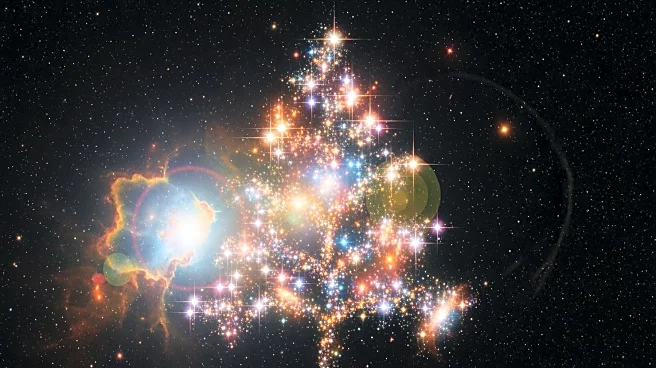
Astronomers have identified a star-forming region in space that resembles a Christmas tree, known as NGC 2264. Located approximately 2,700 light-years away, this region is filled with newborn stars that illuminate
clouds of gas and dust. The area features the Christmas Tree cluster, the Cone Nebula, and the Fox Fur Nebula. The Cone Nebula, a tall structure of gas and dust, is shaped by radiation from nearby young stars, while the Fox Fur Nebula, named for its textured appearance, reflects the light of these stars. This cosmic scene is part of the constellation Monoceros and is visible from Earth during certain seasons. The entire region spans nearly 80 light-years, highlighting its vastness and dynamic nature.
Why It's Important?
The discovery of NGC 2264 provides significant insights into the processes of star formation and the dynamic interactions between young stars and their surrounding environments. Understanding these processes is crucial for astronomers as they study the lifecycle of stars and the evolution of galaxies. The illumination of gas and dust by young stars in this region offers a vivid example of emission and reflection nebulae, which are key components in the study of cosmic phenomena. This discovery not only enhances scientific knowledge but also captivates public interest by presenting a visually striking and festive cosmic display.
What's Next?
Future observations and studies of NGC 2264 could provide further insights into the mechanisms of star formation and the influence of young stars on their environments. Astronomers may use advanced telescopes and imaging techniques to explore the region in greater detail, potentially uncovering new information about the composition and behavior of interstellar gas and dust. These studies could contribute to a broader understanding of the universe and the forces that shape it.
Beyond the Headlines
The depiction of NGC 2264 as a cosmic Christmas tree highlights the intersection of science and culture, demonstrating how astronomical phenomena can resonate with human experiences and traditions. This connection may inspire educational initiatives and public engagement with astronomy, fostering a greater appreciation for the universe and its wonders. Additionally, the study of such regions can inform discussions on the origins of life and the conditions necessary for planetary systems to develop.