
What's Happening?
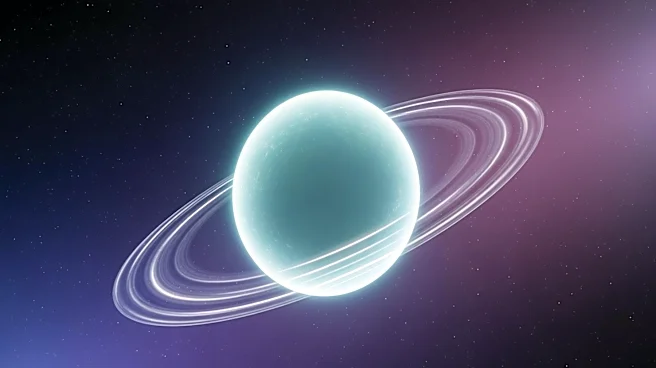
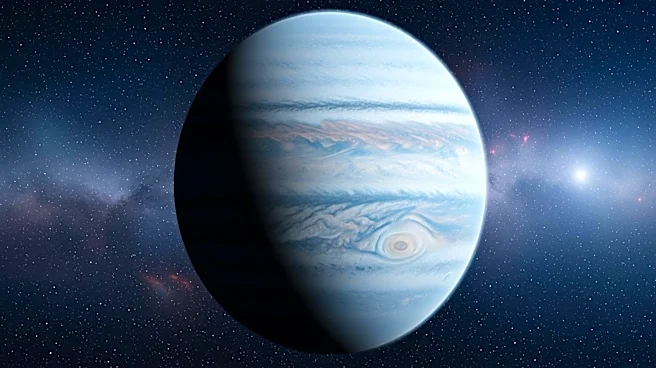
Astronomers using the James Webb Space Telescope (JWST) have discovered water ice clouds on the gas giant Epsilon Indi Ab, challenging existing models of exoplanet atmospheres. The planet, similar to Jupiter,
has a complex atmosphere that was studied using JWST's mid-infrared instrument MIRI. The planet orbits its star at a distance four times that of Jupiter from the Sun, with a surface temperature between -70 and +20 degrees Celsius. This discovery marks a significant step in the study of exoplanet atmospheres, providing insights into their composition and structure.
Why It's Important?
The discovery of water ice clouds on Epsilon Indi Ab is significant as it challenges current models of exoplanet atmospheres, highlighting the need for more advanced simulations. This finding enhances our understanding of gas giants and their atmospheric dynamics, which is crucial for the broader study of planetary systems. The research also demonstrates the capabilities of JWST in providing detailed observations of distant planets, paving the way for future studies of Earth-like planets and the search for extraterrestrial life. The ability to detect such atmospheric features is a step towards understanding the potential habitability of exoplanets.
What's Next?
Future observations with JWST and other telescopes, such as NASA's upcoming Nancy Grace Roman Space Telescope, are expected to provide clearer views of exoplanetary atmospheres. Researchers are seeking additional observation time to study more cold Jupiter-like planets, refining techniques for studying Earth-like worlds. These efforts will build the foundation for future missions aimed at detecting signs of life beyond our solar system. As technology advances, astronomers hope to gain a deeper understanding of exoplanetary environments and their potential to support life.