




What's Happening?
Scientists are investigating the role of neutrinos, often called 'ghost particles,' in determining whether massive stars explode as supernovas or collapse into black holes. When a massive star exhausts its fuel, its core implodes, generating immense heat
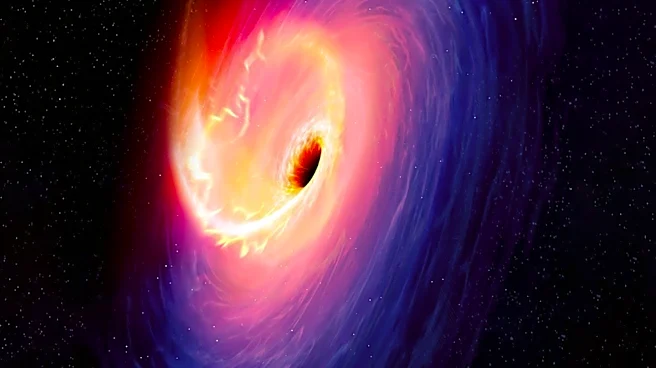
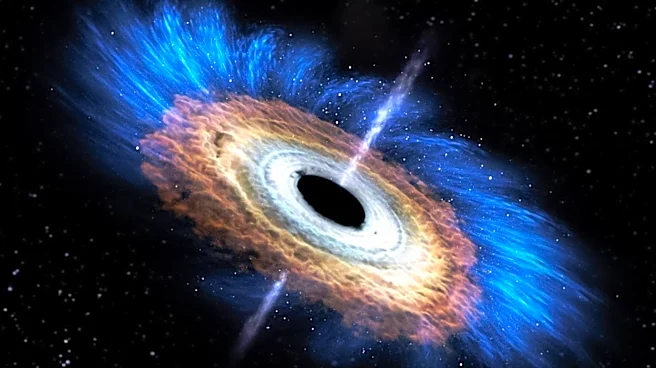
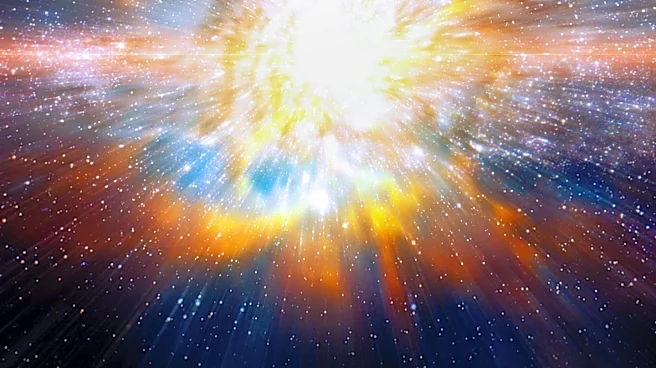
and pressure that crush protons and electrons into neutrons, releasing a flood of neutrinos. These neutrinos can heat the star's outer layers, potentially triggering a supernova explosion and forming a neutron star. However, if this neutrino heating is insufficient, the star may instead collapse directly into a black hole. Researchers, including Mariam Gogilashvili and Irene Tamborra from the University of Copenhagen's Niels Bohr Institute, emphasize that neutrinos carry approximately 99% of the energy released during core collapse, and even minor changes in their behavior can significantly alter a star's ultimate fate. The study involved simulating the collapse of 195 stars, ranging from nine to 120 solar masses, to analyze how neutrino flavor conversion influences these outcomes.
Why It's Important?
Understanding the precise role of neutrinos in stellar collapse is crucial for resolving long-standing cosmic mysteries. For instance, astronomers have observed fewer supernovas than theoretical models predict, and neutrino flavor change could offer an explanation for this discrepancy. Additionally, this research may shed light on why some of the largest red supergiant stars appear to vanish without supernova explosions, potentially collapsing directly into black holes. The findings could also explain the detection of neutron stars with lower masses than previously theorized. By clarifying these processes, scientists can gain deeper insights into how dying stars enriched the universe with the elements necessary for the formation of planets and life, thereby enhancing our comprehension of the cosmos' evolution and the origins of matter.
What's Next?
Future research will focus on incorporating more realistic models of neutrino behavior into three-dimensional computer simulations of massive stars. This will allow scientists to observe how neutrino flavor change initiates and evolves over time as stars die, providing a more dynamic and accurate representation of these complex astrophysical events. Such advanced simulations are expected to offer further insights into the conditions that lead to supernova explosions versus black hole formation. Continued investigation into neutrino properties and their interactions within extreme stellar environments will be key to refining our understanding of stellar evolution and the fundamental forces at play in the universe.
Beyond the Headlines
The study delves into the intricate quantum mechanics of neutrinos, specifically their ability to 'oscillate' or change between three 'flavors' (electron, muon, and tau). This phenomenon, which earned the 2015 Nobel Prize in Physics, is now being explored for its impact on macroscopic cosmic events. Previously, flavor change was thought to have a negligible effect on stellar collapse. However, given the enormous number of neutrinos generated during a star's death, they are concentrated enough to interact with each other, triggering significant flavor changes within the collapsing core. This highlights how subtle quantum phenomena can have profound implications for the largest structures and events in the universe, bridging the gap between the subatomic and the cosmic scales.