
What's Happening?
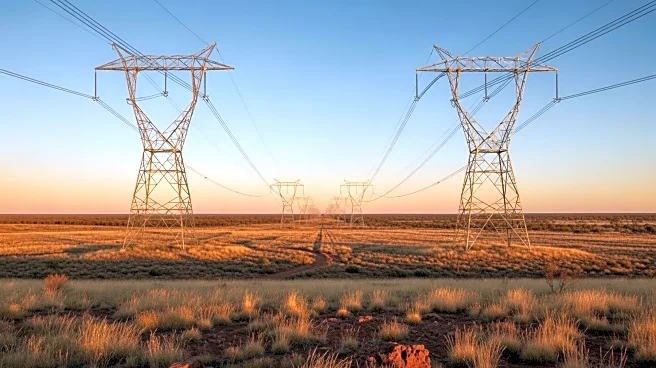
Australia's grid operator has announced an ambitious plan to construct 10,000 kilometers of new transmission lines. This initiative aims to connect renewable energy resources from the inland northern regions
to the densely populated southeastern areas. The goal is to reduce wholesale electricity costs by 8% to 18%. However, the project faces significant hurdles, including cost overruns and community opposition. Despite offering compensation of up to $200,000 per kilometer to landowners, some communities are resisting the construction of new power lines. The existing transmission infrastructure, primarily high-voltage alternating current (HVAC), is inadequate for long distances, prompting the consideration of high-voltage direct current (HVDC) lines, which are more efficient over long distances. The plan is crucial for integrating renewable energy sources, as solar and wind projects are currently struggling to secure grid access.
Why It's Important?
The expansion of transmission lines is critical for Australia's transition to renewable energy and achieving net-zero emissions. By connecting remote renewable resources to urban centers, the plan could significantly lower electricity costs and enhance energy security. The project also highlights the global challenge of modernizing aging power infrastructure to accommodate green energy. Successful implementation could serve as a model for other countries facing similar challenges. However, the opposition from local communities underscores the need for effective stakeholder engagement and compensation strategies. The outcome of this project could influence public policy and investment in renewable energy infrastructure, impacting economic stakeholders and the broader society.
What's Next?
The next steps involve addressing community concerns and finalizing the routes for the new transmission lines. The grid operator will need to engage with local governments and communities to secure buy-in and mitigate opposition. Policymakers may also explore integrating energy storage solutions, such as pumped-hydro schemes, to complement the new transmission lines. The project's progress will be closely monitored by industry stakeholders, as its success or failure could have significant implications for future renewable energy projects and infrastructure development.
Beyond the Headlines
The project raises important questions about the balance between infrastructure development and community rights. The resistance from local communities highlights the ethical considerations of imposing large-scale projects on rural areas. Additionally, the reliance on HVDC technology could drive innovation and investment in this area, potentially leading to advancements in transmission efficiency and cost reduction. The project also emphasizes the need for comprehensive planning and prioritization of transmission corridors to maximize the benefits of renewable energy integration.