







What's Happening?
Hongli "Julie" Zhu, an associate professor at Northeastern University's College of Engineering, has been recognized with the 2027 Research Excellence Award in Electrochemical Energy Storage from the American Chemical Society's Energy and Fuel Division.
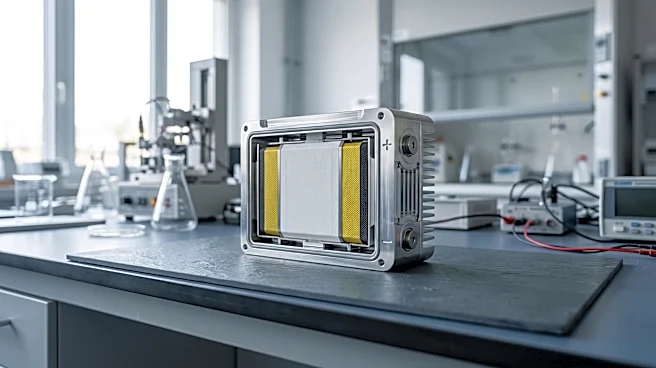
Professor Zhu is developing cutting-edge solid-state batteries designed to be safer and longer-lasting than current lithium-ion batteries. Her research focuses on replacing the liquid electrolyte core, which can cause fires, with a solid ceramic core that utilizes sulfur-ions. This innovative design aims to prevent thermal runaway, a chain reaction that leads to battery fires. Zhu's work, spanning over a decade, has garnered global recognition, with her publications cited over 26,000 times on Google Scholar Citations. The award highlights her significant contributions to the field of energy storage.
Why It's Important?
The development of safer and more efficient batteries, such as those being researched by Professor Zhu, holds significant importance for various U.S. industries and consumers. Current lithium-ion batteries, prevalent in electric vehicles, smartphones, and other devices, pose a fire risk due to their liquid electrolyte. The U.S. Consumer Product Safety Commission reported at least 25,000 incidents of fire or overheating in lithium-ion batteries between 2020 and 2025. Zhu's solid-state battery technology could mitigate these risks, leading to enhanced safety in transportation, electronics, and energy storage systems. This innovation could also reduce economic losses associated with battery-related incidents and potentially influence regulatory standards for battery safety. Industries reliant on portable power, from automotive to consumer electronics, stand to gain from more reliable and secure energy solutions.
What's Next?
Professor Zhu's ongoing research will likely continue to refine the design and production methods for solid-state batteries. While many companies and scientists are working on similar technologies, the limitations have often been design and production costs. Future steps will involve addressing these challenges to make solid-state batteries commercially viable and scalable. The recognition from the American Chemical Society could attract further funding and collaborations, accelerating the development and eventual integration of these safer batteries into mainstream applications. Continued advancements in this area could lead to a significant shift in battery technology, impacting manufacturing processes, supply chains, and consumer product safety standards across the U.S.
Beyond the Headlines
The shift towards solid-state battery technology, as championed by Professor Zhu's research, represents a fundamental change in how energy is stored and utilized. Beyond the immediate safety benefits, this innovation could have profound long-term implications for environmental sustainability by enabling more durable and potentially recyclable energy solutions. The reduced risk of fire could also influence public perception and adoption rates of electric vehicles and other battery-powered technologies. Furthermore, the development of advanced materials like the ceramic core with sulfur-ions could spur new research avenues in materials science and engineering, fostering a new generation of scientific breakthroughs. This technological evolution could redefine energy independence and security for the U.S. by providing more robust and reliable power sources.