



What's Happening?
Astronomers have observed a white dwarf star emitting a multicolored shockwave as it moves through space. This phenomenon was detected using the European Southern Observatory's Very Large Telescope. The white dwarf, part of a binary system located about
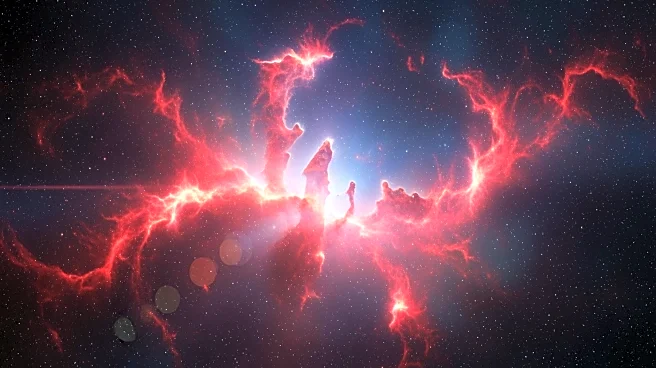
730 light-years from Earth in the constellation Auriga, is siphoning gas from its companion star. The shockwave, known as a bow shock, is created as material from the white dwarf collides with interstellar gas, producing a colorful display. The colors represent different chemical elements: red for hydrogen, green for nitrogen, and blue for oxygen.
Why It's Important?
This discovery provides new insights into the behavior of white dwarfs and their interactions with surrounding space. Understanding these shockwaves can help astronomers learn more about the life cycles of stars and the dynamics of binary systems. The findings could also contribute to broader astrophysical research, including the study of stellar evolution and the conditions in interstellar space. The unusual nature of this white dwarf, which lacks a gas disk typically seen in similar systems, presents a unique opportunity for further investigation.
What's Next?
Researchers will likely continue to study this white dwarf to understand the mechanisms behind the observed shockwave. Further observations and theoretical modeling may reveal why this system behaves differently from others. The ongoing research could lead to new discoveries about the processes governing white dwarfs and their environments, potentially influencing future studies in astrophysics.