
What's Happening?
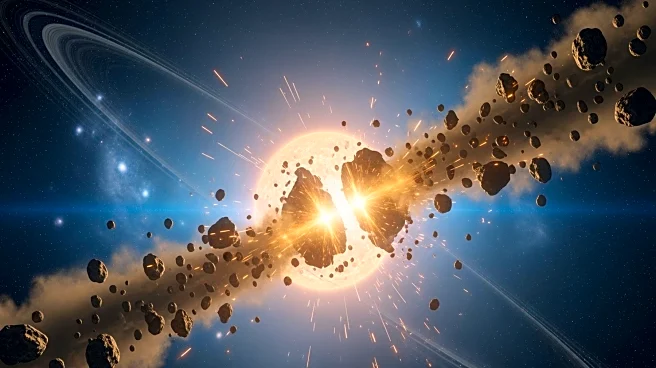
NASA's Hubble Space Telescope has directly imaged asteroid collisions in the Fomalhaut system, a nearby planetary system 25 light-years from Earth. Initially identified as a potential exoplanet, the object
known as Fomalhaut b is now understood to be a dust cloud from colliding planetesimals. A second similar event, labeled cs2, was also observed, challenging previous theories about the frequency of such collisions. These findings provide a rare opportunity to study the aftermath of cosmic collisions and the behavior of planetesimals, which are crucial for understanding planetary formation.
Why It's Important?
The discovery of these collisions is pivotal for the field of astronomy, as it offers a cautionary tale for future missions aiming to detect exoplanets. The transient nature of the observed dust clouds could lead to misinterpretations, affecting the accuracy of exoplanet detection. This research emphasizes the importance of distinguishing between actual planets and debris clouds, which is essential for the success of upcoming space missions. Additionally, the study provides valuable data on the size and composition of planetesimals, contributing to our understanding of planetary system evolution.
What's Next?
The research team plans to use the James Webb Space Telescope to further investigate the Fomalhaut system. By observing the cs2 dust cloud, they aim to gather information on its evolution and composition, including the presence of water ice. These observations will help refine techniques for identifying exoplanets and improve our understanding of planetary system dynamics. The ongoing study will also explore the potential for future collisions and their impact on the surrounding environment.