







What's Happening?
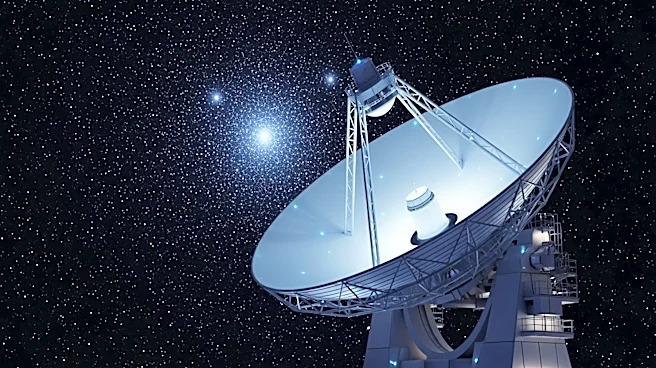
Chinese astronomers have discovered six new millisecond pulsars in two globular clusters, NGC 6517 and NGC 7078, in our galaxy. The discovery was facilitated by the Five-hundred-meter Aperture Spherical radio Telescope (FAST) and an unconventional data
processing method. Millisecond pulsars are ultra-dense neutron stars with powerful magnetic fields that rotate and emit radio waves. The newly discovered pulsars are isolated, lacking nearby companion stars, which is unusual as pulsars typically 'spin up' in binary systems. The discovery increases the known pulsars in NGC 6517 by 27% and in NGC 7078 by nearly 20%, contributing to the GC-FANS survey's findings of over 60 pulsars in 16 clusters.
Why It's Important?
The discovery of these isolated millisecond pulsars challenges existing theories about pulsar formation, which typically involve binary systems. This finding suggests that more sensitive detection methods can reveal previously unnoticed astronomical objects, even in well-studied clusters. The increase in known pulsars enhances our understanding of globular clusters and the dynamics within them, potentially leading to new insights into the evolution of neutron stars and the gravitational interactions in dense star environments. This research underscores the importance of advanced telescopes and innovative data processing techniques in expanding our knowledge of the universe.