



What's Happening?
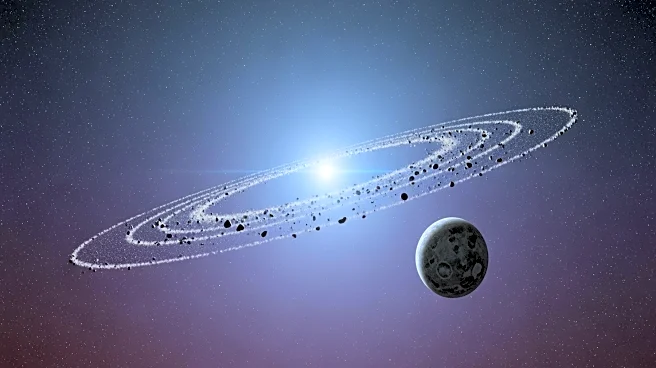
Astronomers have identified a new dwarf planet candidate, Fomalhaut cs2, in the Fomalhaut system. This object is believed to be a cloud of dust resulting from the collision of two large asteroids or planetesimals, each approximately 60 kilometers in diameter.
This discovery sheds light on the nature of Fomalhaut b, previously thought to be a planet, but now understood to have been a similar dust cloud. The observations were made using advanced telescopes, including the Hubble Space Telescope, and the findings were published in reputable scientific journals. The Fomalhaut system, located about 25 light-years away, has been a subject of interest due to its history of strange observations, including the debated existence of Fomalhaut b.
Why It's Important?
The identification of Fomalhaut cs2 as a dust cloud rather than a planet has significant implications for our understanding of planetary formation and the dynamics of young star systems. It suggests that collisions between large celestial bodies may be more common than previously thought, providing a unique opportunity to study these events in real-time. This discovery could offer insights into the early conditions of our own solar system and the processes that lead to planet formation. The findings also highlight the importance of using advanced observational techniques to accurately interpret celestial phenomena, which can influence future astronomical research and exploration.
What's Next?
Astronomers plan to continue observing the Fomalhaut system using both the Hubble Space Telescope and the James Webb Space Telescope (JWST) to monitor the behavior of Fomalhaut cs2 and search for the now-dimmer Fomalhaut b. These observations aim to provide further insights into the frequency and nature of such collisions in young star systems. The ongoing research will help refine models of planetary system formation and improve our understanding of the distribution and behavior of dust clouds in space.