





What's Happening?
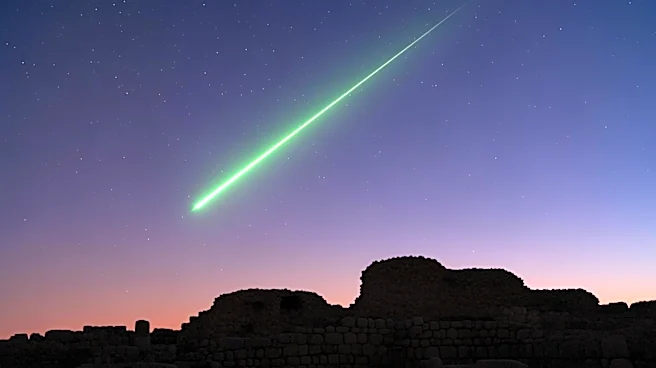
A rare green fireball meteor exploded over Lindisfarne Castle in northeast England, creating a spectacular display captured by local photographers. The meteor, traveling at 20,000 mph, disintegrated in the atmosphere, producing a bright emerald-green
glow. This event, occurring on April 13, was visible from multiple countries, including the UK, Belgium, the Netherlands, and Germany. The meteor's green hue is attributed to high levels of magnesium and nickel, which emit a brilliant light when interacting with Earth's atmosphere. The fireball was captured on various security cameras, and over 230 people reported the sighting to the American Meteor Society.
Why It's Important?
The occurrence of such a meteor highlights the ongoing 'fireball season,' which sees an increase in these events from February to April. This phenomenon is significant for both scientific observation and public interest, as it provides opportunities for researchers to study the composition and behavior of meteors. The widespread visibility and public reporting of the fireball underscore the growing interest in astronomical events and the role of citizen science in documenting them. Additionally, the event adds to the historical significance of Lindisfarne, a site known for its cultural heritage.
What's Next?
While the likelihood of meteor fragments reaching Earth is minimal, the event contributes to ongoing research into meteor activity and atmospheric interactions. Scientists may continue to analyze data from this and similar events to better understand the conditions that lead to such spectacular displays. Public interest in astronomical phenomena is likely to remain high, encouraging further engagement with scientific communities and educational outreach.
Beyond the Headlines
The cultural and historical context of Lindisfarne adds a unique dimension to the meteor event. Known as 'Holy Island,' Lindisfarne has been a site of historical invasions and cultural shifts. The meteor's appearance over such a location may inspire renewed interest in the island's history and its role in both past and present narratives. This intersection of natural phenomena and cultural heritage highlights the interconnectedness of science and history.