
What's Happening?
A recent study published in Nature challenges the long-held belief that high atmospheric oxygen levels were necessary for the existence of giant prehistoric insects. Led by Edward Snelling from the University
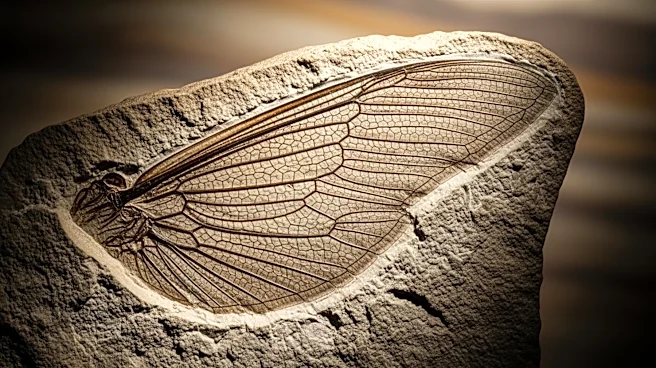
of Pretoria, the research utilized high-power electron microscopy to examine the relationship between insect body size and the number of tracheoles in flight muscles. The findings revealed that tracheoles occupy only about 1% or less of the flight muscle in most insect species, suggesting that oxygen availability does not limit insect flight muscles. This contradicts previous theories that linked the large size of ancient insects, such as griffinflies, to higher oxygen levels 300 million years ago. The study indicates that insects could theoretically increase their tracheole numbers without significant structural changes, challenging the notion that oxygen diffusion limits insect size.
Why It's Important?
This study is significant as it revises the understanding of factors that influenced the size of prehistoric insects, which has implications for evolutionary biology. By debunking the oxygen theory, the research opens new avenues for exploring other factors that may have contributed to the large size of ancient insects, such as predation pressures or physical limitations of the exoskeleton. This could lead to a deeper understanding of evolutionary processes and adaptations in response to environmental changes. Additionally, the study highlights the potential for insects to adapt to varying oxygen levels, which could have implications for understanding how current and future environmental changes might impact insect populations.