




What's Happening?
U.S. Senator Cindy Hyde-Smith (R-MS) has suggested that supporters of her Democratic challenger, Scott Colom, may have been involved in a 2023 shooting incident near her home. The comments were captured in an audio recording from an August 31 campaign
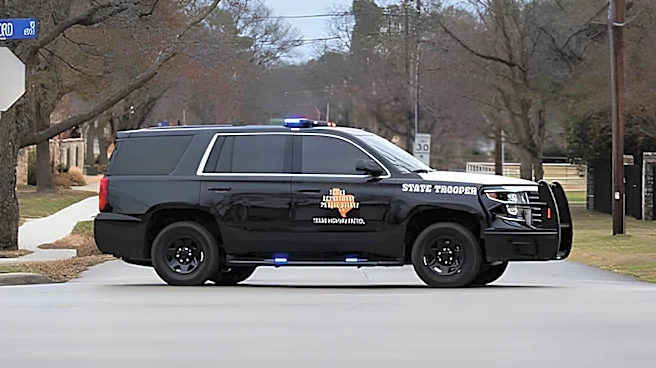
event in Brookhaven, obtained by American Bridge 21st Century, a progressive super PAC. In the recording, Hyde-Smith discusses a 'guy who shot at us' and then links the incident to her opponent, stating, 'my opponent, he has got his hands in so many different places. We have to be very careful.' When asked if she thought Colom was 'hiring people,' she responded, 'People are just crazy out there. Maybe not him doing it, they're just supporting him and they get caught up in it.' A spokesperson for her campaign confirmed she was referring to an October 2023 shooting near her home, which the U.S. Capitol Police investigated. No one was harmed in the shooting, and it was unclear at the time if it was intentional or if she was targeted. Colom, who was not a candidate for U.S. Senate in October 2023, called the remarks 'offensive,' emphasizing his role as a district attorney who prosecutes violence.
Why It's Important?
Senator Hyde-Smith's remarks are significant as they introduce serious, unsubstantiated allegations into a U.S. Senate race, potentially escalating political tensions and distrust. Accusing an opponent's supporters of involvement in a shooting, even indirectly, can inflame partisan divisions and contribute to a hostile political climate. Such statements can also undermine public confidence in the electoral process by suggesting that political opposition is linked to violence. For Scott Colom, the Democratic challenger, these comments could be damaging, forcing him to defend against implications of association with violent acts, despite his role as a prosecutor. The NAACP's Mississippi conference director, Charles Taylor, highlighted the racial undertones of Hyde-Smith's comments, drawing parallels to her controversial 2018 remark about attending a 'public hanging.' This historical context amplifies concerns about the senator's rhetoric and its potential impact on minority voters and broader race relations within the state.
What's Next?
The immediate aftermath of these revelations will likely see increased scrutiny on Senator Hyde-Smith's campaign and further demands for clarification regarding her statements. Scott Colom's campaign is expected to continue to denounce the allegations and focus on policy issues, potentially using Hyde-Smith's comments to highlight what they perceive as divisive rhetoric. Media outlets will likely press Hyde-Smith's campaign for direct answers regarding her belief in Colom supporters' involvement in the shooting, as her campaign officials previously did not respond to such questions from the Clarion Ledger. The U.S. Capitol Police may face renewed inquiries about the status and findings of their investigation into the 2023 shooting. Furthermore, civil rights organizations like the NAACP will likely continue to monitor and comment on the racial implications of the senator's remarks, potentially mobilizing voters in response. The incident could also influence voter perception and turnout as the election approaches, with both campaigns likely leveraging the controversy to rally their respective bases.
Beyond the Headlines
This incident transcends typical campaign rhetoric, touching upon deeper issues of political discourse, the weaponization of unsubstantiated claims, and the erosion of civility in U.S. politics. The suggestion of a link between political support and violence, without concrete evidence, can normalize dangerous narratives that contribute to real-world threats against public officials and political figures. It also highlights the role of third-party groups, like American Bridge 21st Century, in shaping campaign narratives through opposition research and audio recordings. The historical context of Senator Hyde-Smith's previous controversial remarks, particularly the 'public hanging' comment, raises questions about accountability for political speech and its long-term impact on public trust and social cohesion. This situation underscores the ongoing challenge of maintaining respectful political debate in an era of heightened polarization and the potential for inflammatory language to have far-reaching consequences on democratic processes and societal norms.