



What's Happening?
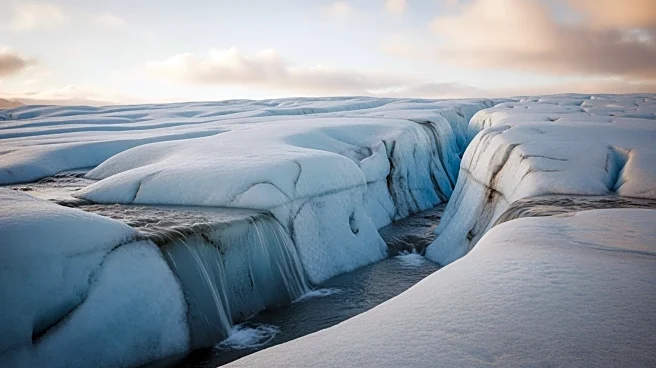
Scientists from the Alfred Wegener Institute have observed significant changes in Greenland's 79°N Glacier, where a large meltwater lake has been forming and draining repeatedly since 1995. This phenomenon is attributed to rising atmospheric temperatures,
which have led to the development of fractures and channels in the glacier. These changes are causing the glacier to become unstable, with meltwater lifting parts of the ice sheet. The study, published in The Cryosphere, documents seven major drainage events, four of which occurred in the last five years. The research highlights the glacier's response to climate change, as warmer ocean waters and surface meltwater contribute to its destabilization.
Why It's Important?
The instability of Greenland's glaciers is a critical indicator of climate change, with potential implications for global sea levels. As glaciers melt and drain, they contribute to rising sea levels, which can impact coastal communities worldwide. Understanding the mechanisms behind glacier instability helps scientists predict future changes and informs climate policy. The study underscores the urgency of addressing climate change to mitigate its effects on polar regions and beyond. The findings also provide valuable data for improving ice sheet models, which are essential for accurate climate predictions.
What's Next?
Researchers will continue to monitor the 79°N Glacier to assess its long-term stability and the potential for further drainage events. The data collected will be used to refine models of glacier behavior and improve predictions of sea level rise. Collaboration with other scientific institutions will enhance the understanding of glacier dynamics and inform global climate strategies. The study's insights may also guide future research on other vulnerable glaciers, contributing to a comprehensive understanding of polar ice responses to climate change.