




What's Happening?
Both Russia and Ukraine have reported cyberattacks targeting their respective air alert applications. Russia's Emergencies Ministry announced on Monday morning that its app, designed to warn users of incoming drone attacks, experienced a 'massive cyberattack'
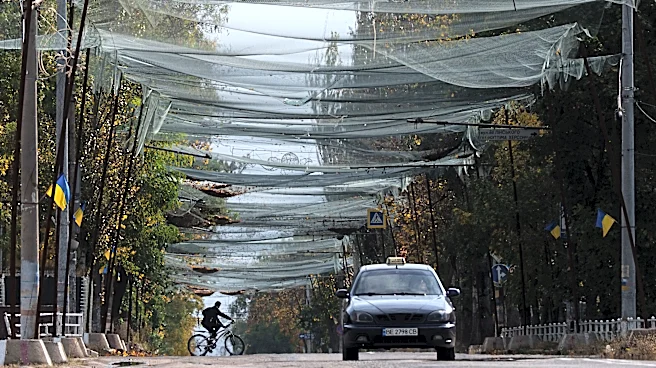
leading to the dissemination of 'false information.' Simultaneously, Ukraine's Air Force stated on Sunday evening that its air alert app was subjected to 'enemy influence,' resulting in fake warnings of nuclear and chemical threats, potential street combat, and an erroneous report of Russia's hypersonic Oreshnik missile deployment in areas around Kyiv. SPRAVDI, Ukraine's Centre for Strategic Communications, attributed the hack to Russia. These cyber incidents follow the conclusion of a localized ceasefire in the Russian-occupied Kherson region, marking a return to heightened hostilities.
Why It's Important?
These cyberattacks on critical public warning systems highlight a significant escalation in the information warfare dimension of the conflict between Russia and Ukraine. For the U.S. and its allies, this development underscores the growing threat of cyber warfare impacting civilian populations and public trust in official communications. The spread of false information, particularly regarding nuclear or chemical threats, can induce widespread panic, disrupt emergency services, and undermine societal stability. This tactic could also be used to test the resilience of digital infrastructure and sow discord within the affected populations. The U.S. has a vested interest in monitoring and understanding these cyber tactics, as similar methods could be employed against its own critical infrastructure or those of its allies, necessitating robust cybersecurity defenses and international cooperation.
What's Next?
Both Russia and Ukraine will likely intensify efforts to secure their digital infrastructure and public warning systems against future cyberattacks. Investigations into the origins and methods of these hacks are expected to continue, potentially leading to new cybersecurity measures and intelligence sharing among allied nations. The U.S. and its partners will likely analyze these incidents to refine their own cyber defense strategies and provide support to Ukraine in bolstering its digital resilience. The use of misinformation through hacked public channels could become a more prevalent tactic in future conflicts, requiring governments to develop more sophisticated methods for verifying information and communicating with their citizens during crises. The end of the localized ceasefire in Kherson suggests a potential increase in conventional military engagements, further intertwining with the ongoing cyber warfare.
Beyond the Headlines
The cyberattacks on air alert apps reveal a deeper implication: the weaponization of information and public fear in modern conflict. Beyond physical destruction, adversaries are increasingly targeting the psychological and social fabric of nations by eroding trust in official channels and creating chaos through misinformation. This form of warfare blurs the lines between combatants and civilians, as the psychological impact extends to the entire population. For the U.S., this trend necessitates not only advanced technical cybersecurity solutions but also robust public communication strategies to counter disinformation and maintain public confidence during crises. It also raises ethical questions about the use of such tactics and the international norms governing cyber warfare, pushing for a re-evaluation of how nations prepare for and respond to hybrid threats that combine conventional and digital aggression.