

What's Happening?
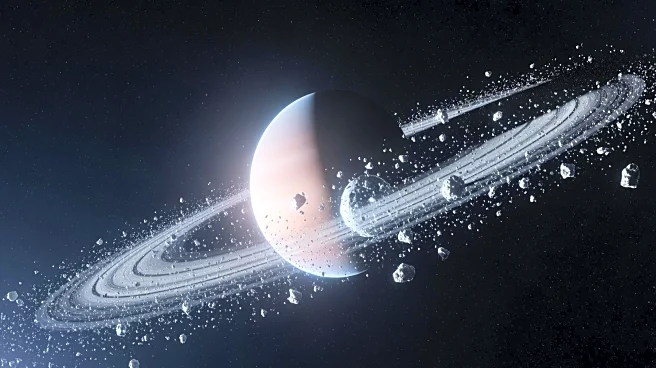
A new study by astronomers, including Matija Ćuk from the SETI Institute, suggests that a collision between Saturn's largest moon, Titan, and a lost moon named Chrysalis could explain the formation of Saturn's rings and the peculiar dynamics of its moons.
The research combines data from the Cassini spacecraft and computer simulations to propose that this collision occurred about half a billion years ago. The event is believed to have resulted in the creation of Saturn's rings and the moon Hyperion, while also affecting Titan's orbit. The study, published in The Planetary Science Journal, provides a comprehensive explanation for several anomalies observed in the Saturnian system, such as the planet's tilt and the rapid outward drift of Titan.
Why It's Important?
This theory offers a unified explanation for several longstanding mysteries about Saturn, including the origin of its rings and the dynamics of its moons. Understanding these phenomena is crucial for planetary science, as it provides insights into the processes that shape planetary systems. The findings could have broader implications for our understanding of celestial mechanics and the history of our solar system. Additionally, the study highlights the importance of combining observational data with theoretical models to solve complex astronomical puzzles.
What's Next?
The upcoming NASA Dragonfly mission, scheduled to launch in 2028, is expected to provide critical data to test this collision theory. By analyzing Titan's surface and collecting samples, Dragonfly could offer evidence to support or refute the proposed scenario. The mission's findings will be pivotal in confirming the role of massive collisions in shaping planetary systems. If the theory is validated, it could lead to a reevaluation of our understanding of Saturn's history and influence future research and exploration missions.