



What's Happening?
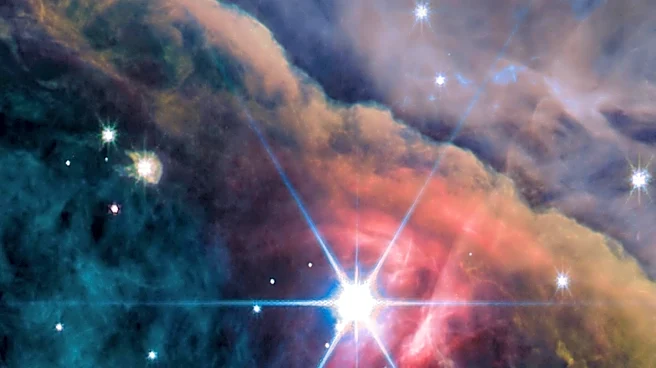
The James Webb Space Telescope has captured a stunning image of the Carina Nebula, revealing intricate details of star formation within this massive star-forming region. Located 7,500 light-years away in the constellation Carina, the nebula is home to
some of the most massive stars in the galaxy and tens of thousands of protostars. The image highlights a feature known as the Treasure Chest, a cometary globule containing a compact cluster of young stars. These stars, some of which are surrounded by circumstellar discs, are responsible for the nebula's glow. The Treasure Chest's shape is influenced by the intense radiation from nearby massive stars, including the Eta Carinae star system.
Why It's Important?
The observations from the James Webb Space Telescope provide valuable insights into the processes of star formation and the impact of massive stars on their environments. By studying regions like the Carina Nebula, astronomers can better understand the lifecycle of stars and the evolution of galaxies. The data collected by Webb will help refine models of star formation and contribute to our knowledge of the universe's structure and dynamics. This research is crucial for advancing our understanding of cosmic phenomena and the fundamental processes that shape the cosmos.
What's Next?
Astronomers will continue to analyze the data from the James Webb Space Telescope to explore the Carina Nebula and other star-forming regions. Future observations will focus on understanding how young stars interact with their surroundings and the mechanisms driving star formation. These studies will enhance our comprehension of stellar evolution and the role of massive stars in shaping their environments. The ongoing research will also inform future missions and guide the development of new technologies for space exploration.