




What's Happening?
The UN refugee agency (UNHCR) has issued a stark warning that nearly 90 million forcibly displaced people are living in countries increasingly exposed to climate-related droughts, floods, and extreme heat. This announcement comes ahead of the COP31 climate summit
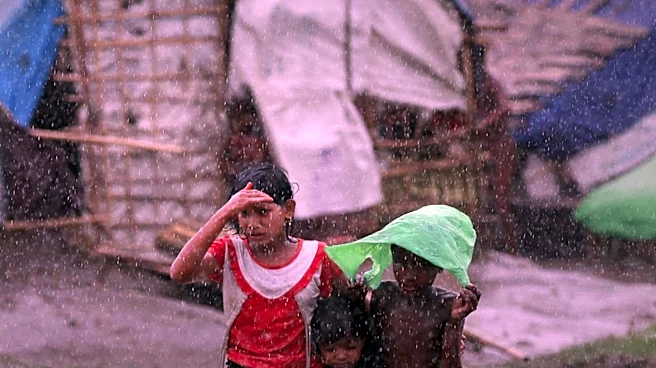
in Antalya, Turkey. According to the UNHCR report, approximately three-quarters of the world's forcibly displaced individuals reside in nations like Afghanistan and Bangladesh, which face severe climate-related risks. Anton Leis Garcia, UNHCR's assistant high commissioner for operations, emphasized that 'climate adaptation in fragile and displacement-affected areas is a matter of survival' and called for increased climate financing to reach the most vulnerable communities. The report highlights the interconnectedness of conflict, displacement, and climate change, noting that climate change is also impeding the sustainable return of displaced people to their homes. In East Africa, severe flooding, potentially exacerbated by a supersized El Niño, could displace up to 3 million people in Somalia, Kenya, South Sudan, and Uganda by the end of this year.
Why It's Important?
This report underscores a critical and escalating humanitarian crisis, linking climate change directly to global displacement and instability. The fact that nearly 90 million displaced people are on the frontlines of climate impacts, despite contributing least to the crisis, highlights a profound injustice. The call for increased climate financing, particularly for fragile and conflict-affected countries, is vital because only about 10% of current climate finance reaches these areas. Without adequate funding and adaptation measures, these populations face renewed displacement, increased vulnerability to extreme weather events, and a greater struggle to rebuild their lives. The potential displacement of millions more in East Africa due to flooding further illustrates the immediate and severe consequences. This situation demands a coordinated international response, integrating humanitarian aid with climate action, to prevent further suffering and ensure the protection of those most at risk.
What's Next?
Ahead of and during the COP31 climate summit, UNHCR will advocate for governments and climate-finance institutions to increase funding for climate adaptation, specifically targeting fragile and displacement-affected countries. They will also call for the inclusion of refugees and other displaced populations in national climate plans and financing mechanisms. The international community will face pressure to address the disparity in climate finance allocation and to develop more robust strategies for climate resilience in vulnerable regions. Furthermore, humanitarian organizations will likely prepare for potential large-scale displacements in East Africa due to the forecasted severe flooding linked to El Niño. The ongoing discussions at COP31 will be crucial in determining the level of commitment and resources allocated to address this growing crisis, with a focus on ensuring that those who have already lost much are not left behind in global climate action.
Beyond the Headlines
The UNHCR's report reveals a deeper ethical and systemic challenge: the disproportionate impact of climate change on populations already marginalized by conflict and displacement. This 'double injustice' highlights the need for a paradigm shift in global climate policy, moving beyond mitigation to robust adaptation strategies that prioritize the most vulnerable. The report implicitly challenges the notion that climate change is solely an environmental issue, framing it as a fundamental human rights and security concern. The lack of adequate climate finance reaching fragile states not only perpetuates humanitarian crises but also undermines efforts towards peace and stability. Addressing this requires not just financial commitments but also a re-evaluation of international aid structures, ensuring that climate resilience building is integrated into all humanitarian and development efforts, and that the voices and needs of displaced communities are central to policy-making.