







What's Happening?
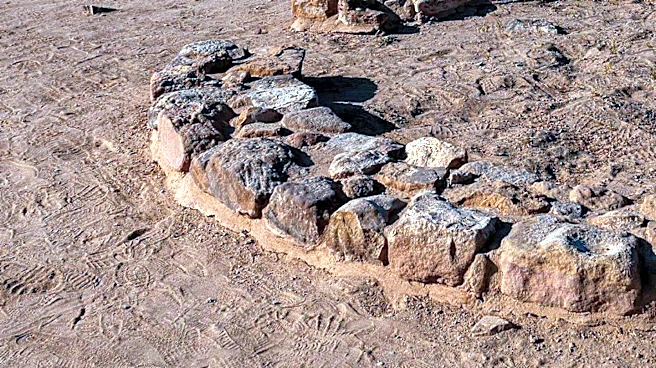
RAF pilots in the 1920s discovered over 6,000 stone structures known as 'desert kites' across the Middle East, which are invisible from the ground. These structures, resembling kites, consist of long stone walls converging into enclosures with tails,
designed to trap animals. The walls, less than a meter high, are strategically placed along slopes to guide animals into pits. The oldest kites date back to the early Holocene, making them some of the most complex structures of their time. While primarily used for trapping wild game, some archaeologists suggest they may have also been used for managing livestock.
Why It's Important?
The discovery of desert kites provides valuable insights into ancient human ingenuity and survival strategies. These structures highlight the sophisticated methods used by early humans to hunt and manage resources in arid environments. Understanding their construction and use can shed light on the social and economic organization of ancient communities. The study of desert kites also contributes to broader archaeological knowledge, offering clues about human adaptation to changing climates and landscapes over millennia.
Beyond the Headlines
The ongoing research into desert kites may reveal more about the cultural and technological advancements of ancient societies. As archaeologists continue to explore these structures, they may uncover new information about the interactions between human populations and their environments. The study of desert kites also raises questions about the preservation of archaeological sites and the impact of modern development on historical landscapes. These findings could influence future conservation efforts and the management of cultural heritage sites.