

What's Happening?
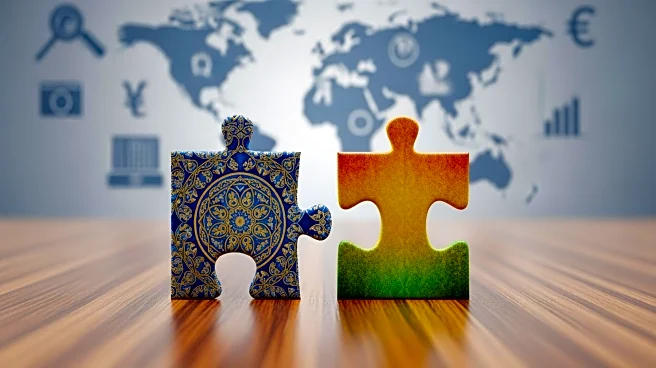
The European Union (EU) and India are on the verge of finalizing a significant free trade agreement, described as 'the mother of all deals,' alongside a defense pact. This development comes as the Trump administration in the United States imposes high
tariffs on Indian goods, prompting India to seek alternative trade partners. The EU aims to strengthen its economic ties with India, the world's fastest-growing major economy, by offering a market for nearly 2 billion people. The agreement is expected to boost trade in goods, which reached €120 billion in 2024, and enhance cooperation in areas such as labor mobility and defense. The EU hopes to attract high-skilled workers from India and explore joint production in the defense industry. The deal also aims to reduce India's reliance on Russian military equipment by diversifying its suppliers.
Why It's Important?
This trade agreement is crucial as it represents a strategic shift in global trade dynamics, particularly in response to the US's protectionist policies under President Trump. By securing a deal with the EU, India can mitigate the economic impact of US tariffs, which have significantly affected its export sectors, including gems, jewelry, and garments. For the EU, the agreement opens up new markets and strengthens its geopolitical influence in Asia, especially as it seeks to counterbalance China's growing economic power. The deal also underscores the EU's commitment to fostering global trade partnerships and reducing dependencies on single markets. Additionally, the defense pact could lead to increased military collaboration, enhancing security ties between the EU and India.
What's Next?
The EU and India are expected to conclude the trade talks at a high-stakes summit in New Delhi, with European Commission President Ursula von der Leyen and Indian Prime Minister Narendra Modi attending. The agreement will likely include provisions for reducing tariffs on European cars and alcohol, while India seeks easier standards for its pharmaceutical exports and duty-free access for textiles. Both parties will need to address sensitive issues such as agricultural market access and steel tariffs, which have been points of contention. The successful implementation of the deal could pave the way for further economic and strategic collaborations between the EU and India.
Beyond the Headlines
The trade agreement could have long-term implications for global trade patterns, potentially reducing India's economic dependence on the US and Russia. It may also influence other countries to pursue similar partnerships, reshaping alliances and economic strategies worldwide. The deal highlights the importance of diversified supply chains and stable international trade relations in an increasingly interconnected global economy. Furthermore, the agreement could serve as a model for future trade negotiations, emphasizing the benefits of cooperation over protectionism.