



What's Happening?
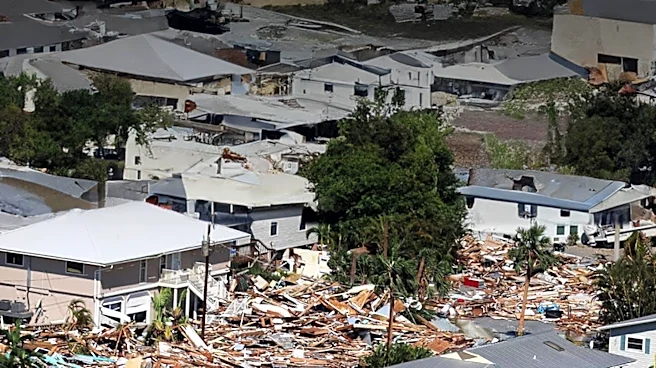
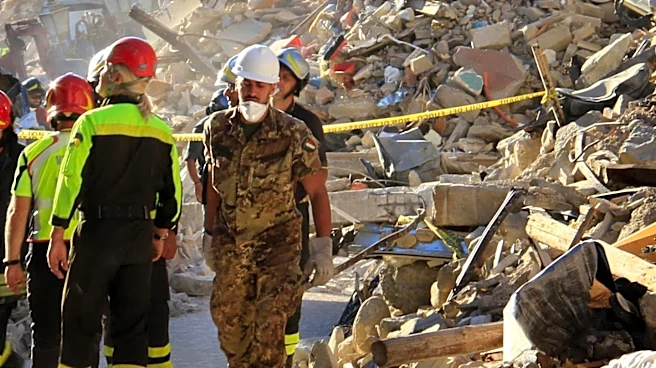
Panama's President Jose Raul Mulino has declared a "major disaster" after a powerful 7.7-magnitude earthquake struck the Central American nation. The shallow tremor, which lasted approximately one minute, caused significant damage, including the destruction
of buildings and roads near its epicenter. While no immediate casualties were reported, the quake led to scenes of panic in Panama City, located about 200 kilometers from the epicenter, where residents evacuated high-rise buildings. The U.S. Geological Survey initially estimated the quake at magnitude 8.0 before revising it to 7.7. The epicenter was 10 kilometers from Pitaloza Arriba in central Herrera province. President Mulino traveled to Penonome to coordinate the disaster response efforts. Despite the widespread shaking and damage, the Panama Canal Authority confirmed that shipping through the vital waterway remained unaffected and continued to operate normally.
Why It's Important?
The declaration of a 'major disaster' by President Mulino underscores the severity of the earthquake's impact on Panama's infrastructure and its citizens. While direct casualties were not immediately reported, the destruction of roads and buildings will necessitate substantial recovery efforts, potentially straining the nation's resources. The panic observed in Panama City's skyscrapers highlights the psychological toll such events can take on urban populations. For the U.S., the continued normal operation of the Panama Canal is crucial, as it is a key global trade artery. Any disruption to the canal could have significant economic repercussions for international shipping and U.S. commerce. The U.S. Geological Survey's involvement in assessing the quake also demonstrates the international scientific community's role in monitoring and responding to such natural disasters, providing critical data for affected regions.
What's Next?
Following the declaration of a major disaster, Panama will likely focus on immediate relief efforts, including assessing the full extent of the damage, providing aid to affected communities, and initiating reconstruction projects for damaged infrastructure and housing. President Mulino's direct involvement in coordinating the disaster response suggests a centralized and urgent approach to recovery. Authorities will continue to monitor for aftershocks and ensure the safety of residents. The long-term recovery will involve significant financial investment and potentially international assistance to rebuild and restore normalcy to the affected areas. The resilience of the Panama Canal's operations will remain a key focus, ensuring its continued functionality for global trade.
Beyond the Headlines
The earthquake in Panama highlights the vulnerability of infrastructure in seismically active regions and the critical importance of robust building codes and disaster preparedness. The panic in Panama City's high-rises underscores the psychological impact of such events, even without immediate casualties, and the need for effective evacuation protocols in urban environments. The swift confirmation of the Panama Canal's operational status also points to the strategic importance of this waterway and the measures in place to ensure its resilience against natural disasters. This event serves as a reminder of the constant threat posed by natural phenomena and the ongoing challenge for nations to develop and maintain infrastructure that can withstand such forces, while also having comprehensive disaster response plans in place.