








What's Happening?
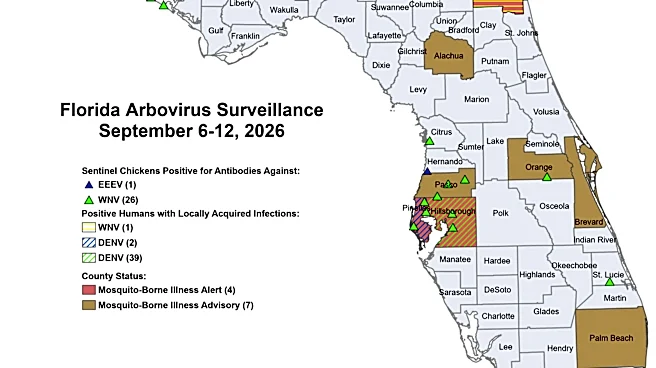
Orange County, Florida, has escalated its mosquito-borne illness status from an advisory to an alert, the first such upgrade since 2011, after health officials confirmed a third locally acquired case of dengue. The Florida Department of Health made the change
after two additional cases were identified within a single household in Apopka, following an earlier case reported in Pine Hills. Steve Harrison, manager of Orange County Mosquito Control, explained that the presence of multiple local cases in different areas triggered the alert. Dengue is transmitted by the Aedes aegypti mosquito, which typically remains within a few blocks of its hatching site. In response, mosquito control crews are conducting door-to-door treatments in Pine Hills and Apopka to eliminate standing water and breeding sites. The county has also implemented new laboratory equipment utilizing PCR detection to rapidly test mosquitoes for viruses, providing results within a single day, a significant improvement over previous methods that took a week or more.
Why It's Important?
The elevation to a mosquito-borne illness alert in Orange County signifies a heightened public health risk and necessitates immediate, aggressive intervention to prevent further spread of dengue. This situation directly impacts residents' health and safety, requiring them to take increased personal precautions. For local businesses, particularly those in tourism and outdoor recreation, a prolonged alert could deter visitors and affect economic activity. The rapid testing capabilities introduced by Orange County Mosquito Control are crucial, as quicker detection allows for more timely and targeted mitigation efforts, potentially containing outbreaks more effectively. This event also highlights the ongoing challenge of managing mosquito-borne diseases in subtropical regions of the U.S., underscoring the need for continuous surveillance, public education, and advanced control technologies to protect communities.
What's Next?
Orange County Mosquito Control will continue its intensified mitigation and surveillance operations in Pine Hills, Apopka, and across the county. This includes door-to-door treatments to eliminate standing water and breeding sites, as well as ongoing testing of mosquito samples using the new PCR technology. Residents are strongly advised to take precautions such as removing standing water from their properties, wearing long sleeves and pants, and using EPA-approved insect repellent. Health officials will closely monitor the situation, and the effectiveness of these measures will determine if the alert status can be downgraded or if further actions are required. The focus remains on proactive measures to reduce the risk of additional local transmission of dengue.
Beyond the Headlines
The dengue alert in Orange County, Florida, underscores the increasing vulnerability of U.S. communities to tropical diseases, a trend potentially exacerbated by climate change and increased global travel. The Aedes aegypti mosquito, a primary vector for dengue, thrives in urban environments and its presence highlights the challenges of controlling disease spread in densely populated areas. The investment in rapid PCR testing technology by Orange County Mosquito Control represents a critical advancement in public health infrastructure, demonstrating a shift towards more agile and data-driven responses to disease outbreaks. This incident could serve as a case study for other U.S. regions facing similar threats, emphasizing the importance of local preparedness, community engagement, and technological innovation in combating emerging and re-emerging infectious diseases.