





What's Happening?
Academy Award-winning filmmaker Laura Poitras, in collaboration with Rachel Lauren Mueller, has co-directed a new documentary short titled 'They’re Here.' The film, which premiered at the Venice Film Festival and is featured in the New York Film Festival,
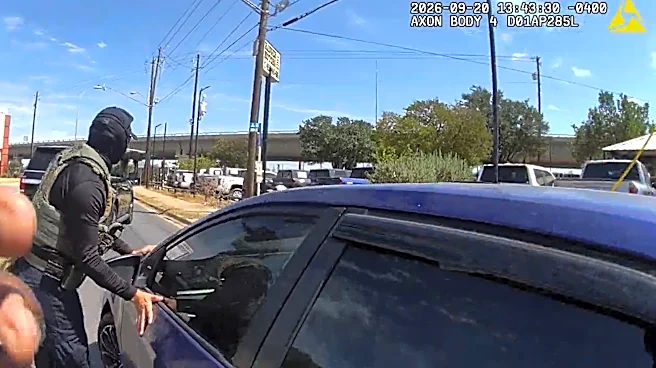
focuses on the operations of Immigration and Customs Enforcement (ICE) in Minneapolis. The 24-minute documentary employs horror tropes to depict the surge of ICE officers in the city during the Trump administration's 'Operation Metro Surge.' This initiative aimed to remove the Somali immigrant population from the Twin Cities and destabilize its progressive political order. The film utilizes dash-cam video, counter-surveillance, and crowdsourced footage to immerse viewers in the anxious atmosphere experienced by Minneapolis residents as they evaded and resisted ICE and Customs and Border Protection agents. The identities of residents are obscured for their protection. The documentary highlights instances of violence, including agents using smoke bombs, physically assaulting protesters, and pepper-spraying citizens. It also features scenes from the Minneapolis-Saint Paul airport, showing detainees being transported on non-commercial airliners to federal detention centers or for deportation.
Why It's Important?
This documentary is important because it offers a critical perspective on U.S. immigration enforcement policies and their impact on local communities. By using horror tropes, the filmmakers aim to challenge the normalization of ICE violence and evoke a sense of terror and fear, reflecting the lived experiences of those affected. The film sheds light on the tactics employed by federal agents during 'Operation Metro Surge,' which targeted specific immigrant populations and aimed to disrupt the political landscape of a major U.S. city. The documentary's focus on Minneapolis, a city with a history of resistance and activism, underscores the ongoing tensions between federal immigration policies and local community efforts to protect residents. It also highlights the role of citizen journalism and crowdsourced footage in documenting and exposing government actions, providing an alternative narrative to official accounts. The film's portrayal of the human cost of these operations, including the personal testimony of an immigrant like Edén Villa, brings a crucial emotional dimension to the broader debate on immigration.
What's Next?
The documentary's premiere at significant film festivals like Venice and New York suggests it will gain considerable attention and likely spark further discussions about U.S. immigration policies and the actions of ICE. The filmmakers, Poitras and Mueller, aim to put the audience in a position of terror and fear, which could lead to increased public awareness and potentially influence public opinion regarding immigration enforcement. The film's release may also prompt reactions from civil society groups, human rights organizations, and political leaders, potentially leading to renewed calls for accountability and reform within immigration agencies. While the Department of Homeland Security's tactics have reportedly shifted from overt 'shock-and-awe' to more subtle approaches, the documentary serves as a historical artifact, documenting past events and their impact. Its continued screening and distribution could contribute to a broader understanding of the long-term implications of such operations on American society and its diverse communities.
Beyond the Headlines
Beyond its immediate focus on ICE operations, 'They’re Here' delves into deeper ethical and cultural dimensions of surveillance, resistance, and the power dynamics between state authority and individual citizens. The film's use of horror as a narrative device is a powerful artistic choice, aiming to reframe the audience's perception of events that might otherwise be desensitized by traditional news reporting. It highlights the psychological impact of living under constant threat of enforcement and the ways communities mobilize to protect their own. The documentary also implicitly raises questions about the role of media and filmmaking in documenting moments of crisis and violence, and how art can serve as a tool for truth-telling and emotional engagement. The film's emphasis on the resilience and resistance of Minneapolis residents, drawing on the city's history of activism, suggests a long-term shift in how communities respond to perceived abuses of power, fostering networks of support and counter-surveillance. This underscores the evolving relationship between citizens and law enforcement in an increasingly surveilled society.