

What's Happening?
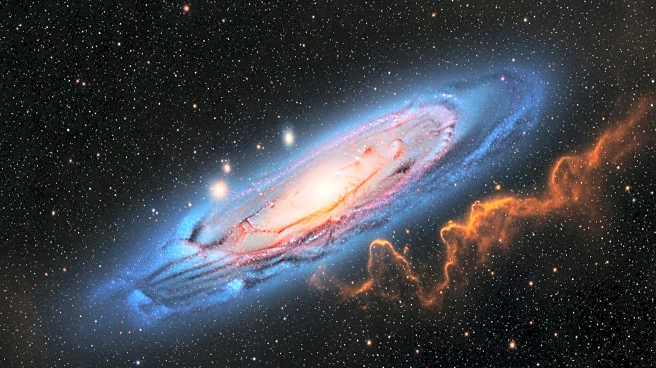
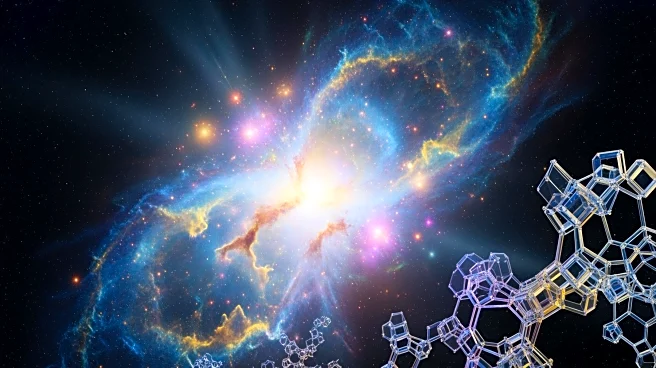
The James Webb Space Telescope (JWST) has made a significant discovery in the galaxy IRAS 07251-0248, identifying a variety of small organic molecules that could serve as the precursors to life. Using its Near InfraRed Spectrograph (NIRSpec) and Mid-Infrared
Instrument (MIRI), the JWST was able to penetrate the dense dust and gas that obscure the galaxy's core, revealing a complex chemical environment. The research team, led by Ismael García Bernete from the Center for Astrobiology, found an unexpected abundance of molecules such as benzene, methane, and the methyl radical, which has never been detected outside the Milky Way. These findings suggest a rich chemical network fueled by a continuous source of carbon, potentially driven by cosmic rays fragmenting larger carbon-rich dust grains.
Why It's Important?
This discovery is crucial as it provides insights into the chemical processes that could lead to the formation of life-supporting molecules in extreme galactic environments. The presence of these organic molecules in such abundance challenges existing theoretical models and suggests that galactic nuclei like that of IRAS 07251-0248 could be prolific sites for the production of life's building blocks. This could have profound implications for our understanding of life's potential beyond Earth, indicating that the conditions necessary for life might be more common in the universe than previously thought.
What's Next?
Future research will likely focus on further exploring these galactic nuclei to understand the processes that lead to such chemical complexity. Scientists may also investigate other galaxies with similar characteristics to determine if this phenomenon is widespread. Additionally, the role of cosmic rays in fragmenting larger molecules and contributing to this chemical richness will be a key area of study, potentially leading to new insights into the conditions that foster the development of life-supporting molecules.
Beyond the Headlines
The findings from the JWST could reshape our understanding of prebiotic chemistry, highlighting the importance of small organic molecules in the formation of more complex structures like amino acids and nucleotides. This research underscores the potential for life to arise in diverse and extreme environments, expanding the scope of astrobiology and the search for extraterrestrial life. The study also emphasizes the need for advanced telescopes like the JWST to probe the universe's hidden corners, revealing the intricate chemical processes that occur in distant galaxies.