



What's Happening?
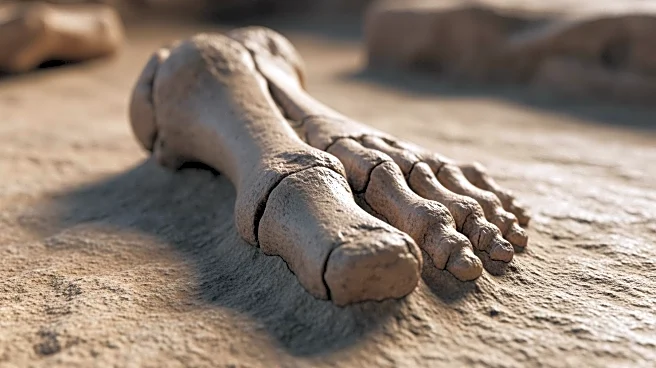
A recent study has proposed that the 'Little Foot' fossil, a nearly complete hominin skeleton found in South Africa's Sterkfontein Caves, may belong to a previously unidentified human species. Initially classified under the genus Australopithecus, the fossil has been
reexamined by an international team of researchers who argue that it does not fit neatly into existing species categories. The study suggests that Little Foot, formally known as StW 573, exhibits a unique combination of anatomical traits that do not align with known species such as Australopithecus africanus or Australopithecus prometheus. This finding could reshape our understanding of human evolution and the diversity of early hominins.
Why It's Important?
The potential identification of a new human species from the Little Foot fossil has significant implications for the study of human evolution. It challenges existing classifications and suggests a more complex evolutionary history with multiple hominin species coexisting in the same region. This discovery could lead to a reevaluation of evolutionary timelines and the relationships between different hominin species. Understanding the diversity of early human ancestors is crucial for reconstructing the evolutionary pathways that led to modern humans, and it highlights the dynamic nature of human evolution.