







What's Happening?
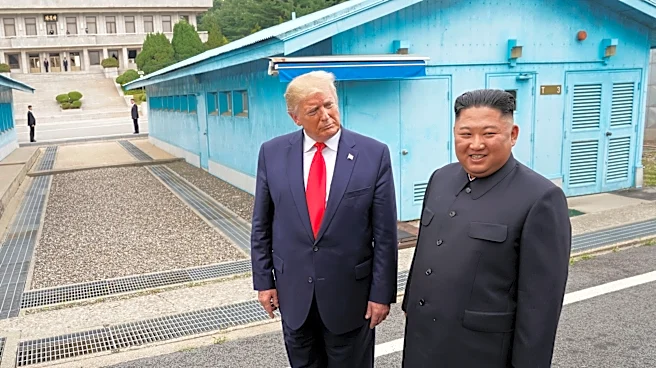
President Trump's administration has initiated a significant redefinition of the U.S.-South Korea relationship, moving its primary focus from security cooperation to economic partnership. This shift was highlighted by President Trump's decision last week
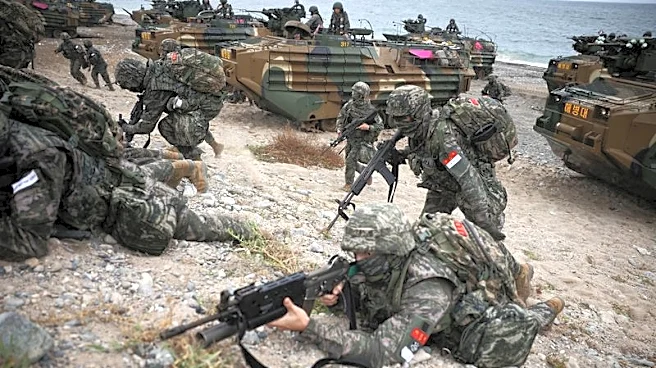
to scale back annual military drills with South Korea. This move coincided with Seoul finalizing substantial investment commitments to Washington, totaling hundreds of billions of dollars. Experts suggest that President Trump's frustration over U.S. military spending overseas and the perceived slow implementation of South Korea's investments are key drivers behind this change. The U.S. Commerce Department and the Korean Trade Ministry did not comment on these developments. This reorientation raises questions about whether economic ties will now serve as the primary basis for U.S. commitment to South Korea's security, a departure from the long-standing military alliance.
Why It's Important?
This redefinition of the U.S.-South Korea alliance carries significant implications for both nations and regional stability. For the U.S., it reflects a broader strategy by President Trump to reduce overseas military spending and prioritize economic interests, potentially freeing up resources for domestic and international investments. However, some experts, like Bruce Klingner, a former senior CIA officer, warn that scaling back military drills could undermine the reliability of the U.S. as a security and economic partner, potentially exacerbating allies' concerns. For South Korea, the shift means that substantial economic investments in the U.S. are now intertwined with security considerations, rather than being a separate aspect of the relationship. This could lead to a more integrated industrial ecosystem between the two countries, with Korean companies increasing investments in U.S. sectors like semiconductors, electric vehicles, and shipbuilding, aligning with President Trump's reindustrialization push.
What's Next?
The future trajectory of the U.S.-South Korea relationship will likely involve continued negotiations and adjustments as both nations navigate this new economic-centric alliance. South Korea's ongoing investments in the U.S., particularly in critical sectors like semiconductors, will be closely watched to see if they solidify the economic foundation of the partnership. The U.S. administration will likely continue to emphasize economic reciprocity and burden-sharing in its alliances. There may be further discussions regarding the scope and nature of future military exercises, potentially leading to more tailored or scaled-down drills. The long-term impact on regional security dynamics, especially concerning North Korea, remains a key area of observation, as allies assess the implications of a potentially reduced U.S. military footprint in Asia.
Beyond the Headlines
Beyond the immediate policy changes, this shift in the U.S.-South Korea alliance highlights a broader trend in international relations where economic leverage is increasingly being used as a tool in security partnerships. It raises questions about the sustainability of traditional military alliances in an era of evolving global economic and political landscapes. The emphasis on 'integrated industrial ecosystems' suggests a deeper intertwining of national economies, where trade and investment become integral components of strategic alliances. This approach could set a precedent for how the U.S. engages with other allies, potentially leading to a re-evaluation of security commitments based on economic contributions. The ethical implications of linking security guarantees to economic investments, and the potential for such a model to create new dependencies or vulnerabilities, will be a subject of ongoing debate.