







What's Happening?
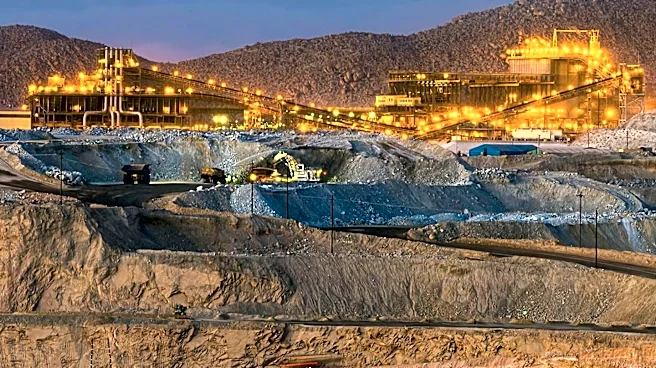
China has initiated a groundbreaking industrial-scale facility designed to extract iron from previously discarded mine tailings and low-grade ore. This development, confirmed by the Chinese Academy of Sciences (CAS), involves a production line capable
of processing 5.56 million tonnes of refractory iron ore and tailings annually, which has successfully passed official checks and is now operational. China, the world's largest iron ore consumer, currently imports over 80% of its supply, primarily from Australia and Brazil. Despite possessing the fourth-largest iron ore reserves globally, much of it is low-grade and difficult to process using conventional methods. This new technology aims to make these previously unviable ores economically extractable, transforming waste into a valuable resource and significantly bolstering China's domestic iron supply capabilities.
Why It's Important?
This technological breakthrough holds immense strategic importance for China, as it directly addresses the nation's long-standing vulnerability due to its heavy reliance on iron ore imports. By leveraging its vast reserves of low-grade ore and mine tailings, China can enhance its resource security and reduce its susceptibility to global supply chain disruptions and price fluctuations. This move could significantly alter the global iron ore market dynamics, potentially impacting major exporting nations like Australia and Brazil. Furthermore, it represents a significant step towards sustainable resource management, transforming industrial waste into a valuable commodity. The success of this industrial-scale extraction could also inspire other nations with similar resource challenges to invest in advanced processing technologies for low-grade and waste materials, promoting a more circular economy in the mining sector.
What's Next?
The successful operation of this new facility is expected to lead to further expansion of similar projects across China, as the nation seeks to maximize its domestic iron ore utilization. This could result in a gradual decrease in China's demand for imported iron ore over the long term, potentially shifting global trade patterns and commodity prices. Other countries may closely observe China's progress, potentially investing in similar technologies to enhance their own resource independence and environmental sustainability. The development also signals a broader trend towards technological innovation in mining, focusing on efficiency and waste reduction. Future developments will likely include research into even more advanced extraction methods and the application of these techniques to other critical minerals found in mine tailings.
Beyond the Headlines
Beyond its immediate economic and strategic implications, China's initiative in extracting iron from tailings represents a significant paradigm shift in resource management. It challenges the traditional linear model of resource extraction and waste generation, moving towards a more circular and sustainable approach. This development could set a precedent for how nations view and manage their mineral resources, encouraging the re-evaluation of existing waste streams as potential future resources. Ethically, it addresses the environmental burden of mining waste by transforming it into an asset, potentially reducing the need for new mining sites and mitigating ecological damage. Culturally, it reinforces China's commitment to technological self-reliance and innovation as a means to overcome resource constraints and achieve national objectives, potentially influencing global industrial policy and environmental standards.